How my brother foretold his future when he was 1 year old

This is my little brother Teddy on his first birthday (dol). In Korea, the first birthday is celebrated as one of life’s most important milestones.

Cardinal ColorsTeddy is wearing the dol-bok, worn for the first birthday celebration. The stripes on his sleeves are in the traditional Korean pattern that incorporates the five “cardinal colors” of Yin and Yang. White represents metal, red represents fire, blue represents wood, black represents water, and yellow represents the earth. This colorful striped pattern is worn only by children and is meant to protect them from evil spirits. The long belt wrapped  around his body represents  longevity. A pouch like the one to the right, is strung on the belt for good luck.

Traditionally, the gods Sanshin and Samshin Halmoni were honored at a first birthday celebration with offerings of food and prayer. Sanshin, the Shaman mountain spirit, (who has also been assimilated into Buddhism), grants prayers for sons. He is always depicted as an old man with a tiger by his side. Samshin Halmoni, or Birth Grandmother, is the Shaman spirit of childbirth.

Symbolism imbues every aspect of the first birthday celebration. With a decorated screen as a backdrop, a round prayer table is set with an abundance of auspicious foods and objects. The roundness of the table ensures a smooth life without conflict and hardship.

To cut a flower would be to cut short the life of a living thing, so only a potted orchid and artificial flowers (both seen on the left) decorate the table. Bronze tableware is used to represent a bright future. Noodles represent long life. The bowl of steamed white rice symbolizes wealth. The association is made explicit by the coins that are actually placed on the rice. Behind the bowl of rice are jujubes, which represent abundance, fertility, and prosperity. Other fruits are piled high in the display. The parsley to the right represents good health, longevity, fertility, and also marriage. Next to the parsley is a skein of thread for longevity, and coins for wealth. Usually one would find a bowl of seaweed soup, closely associated with birth and birthdays. An assortment of rice cakes is also usually present on the table. White rice cakes represent purity, rice cakes coated in red bean powder are meant to ward away misfortune, the multi-hued rice cake seen on the back right is meant to ensure that all of these good wishes for the child will come true.

The birthday celebration culminates with the doljabi ceremony, during which the one year old foretells his future by selecting an object laid out on a table. For our first birthday parties, our family has always set out the three most commonly used objects. If the child chooses the pen, he’ll become a scholar. If he picks money, he’ll be wealthy. If he picks the thread, he’ll live a long life. Sometimes the doljabi can be even more elaborate:

The child who chooses the bow and arrow will become a warrior. The medallion represents fame and prestige. Note the stethoscope and judge’s gavel on this doljabi table!

In the photo of my brother Teddy’s doljabi, you can see him foretelling his future with amazing prescience. He picked up the pen and then jabbed it into his cake. After four straight years on the Dean’s list in college and after a brilliant three years of law school where he distinguished himself as the editor of the law review, Teddy found his true passion as a Crossfit gym owner. Nowadays he writes about nutrition and health on his gym’s blog…

and it was all foretold on his first birthday!

Enhanced by Zemanta

The First 100 Days

After the 21st day of life, the next important Korean milestone is the 100th day of life, or baek-il. This is a relic of the days when infant mortality rates were high, and it was truly an occasion to celebrate when a baby made it to 100 days. On that 100th day, a family would traditionally pray and give food offerings to thank Samshin Halmoni (Birth Grandmother), the Shaman spirit of childbirth. The legend goes that a fifteen year old girl was seduced by a monk and became pregnant. Her scandalized and sanctimonious brothers locked her in a box and left her to die. Fortunately, her mother was able to free her, and she gave birth to triplet sons. Because of this heroic feat, she became Samshin Halmoni: the patron spirit of babies.

A party and feast are traditionally held for a baby’s baek-il. Samshin Halmoni is honored with prayers and food offerings. Red bean cakes are placed at the four compass points around the house to bring good fortune to the baby. It is also the custom to share rice cakes with 100 people to ensure long life for the baby.

The first time I learned about baek-il was when my first son was born. My mother called to tell me we should have a party to celebrate. And so we did!

We had a party for my second son too:

I was looking for photos of my daughter’s 100 day party and sadly realized that we must not have done this for her. This is the fate of third children. I know. I’m a third child myself. I did manage to take pictures of her on her 100th day:

This is a girl who knows how to celebrate, party or no party!

Today I’m leaving for New York City to celebrate my son’s 13th birthday. We will be meeting up with one of his best buddies, who is also turning 13, and his mother, one of my best buddies. I’ll be back some time next week with more birthday stories and pictures to share!

Enhanced by Zemanta

63 Bowls of Seaweed Soup, or: The First 21 Days

In Korea the 21st day of a baby’s life (Saei-rye), the 100th day of life (Baek-il), the 1st birthday (Dol, or Doljanchi) and the 60th birthday (Hwangap) are considered important milestones. Long ago, when infant mortality rates were higher and average life expectancy much lower than they are now, reaching these milestones was truly something to celebrate. Today, though life expectancy has greatly improved, these milestones are still marked with age-old traditions and celebrations.

A Korean mother and her baby are basically in solitary confinement (samchil-il) for the first 21 days of the baby’s life. They are not supposed to leave the house, and no one (except maybe the mother’s mother) is allowed to visit. Traditionally, a straw rope would be hung across the gate in front of the house to announce a baby’s birth and gender, to warn people away, and to ward off evil spirits. If the baby was a boy, anatomically suggestive red chili peppers or tassels in the shape of peppers would be entwined in the rope:

Does this remind you of anything?

Remind you of anything?

Pine twigs, representing longevity and virtue, would announce the birth of a baby girl. Bits of charcoal, representing purity, would be interspersed with the chili peppers and the pine twigs to chase away evil spirits.

When each of our nieces and nephews was born, my siblings and I were dying to go visit the baby right away, but were strictly forbidden to do so by my mother until the baby was 21 days old. When she found out that I had gone to a book fair with one of my own babies only days after giving birth, she was positively apoplectic. During the period of samchil-il, both the new mother and her baby are supposed to stay at home bundled in warm clothing to rest and recover from the ordeal of childbirth.

My son’s birth was indeed an ordeal. After 20 hours of labor, he was born with an alarmingly pointy head, jaundice, and a fever. I had a broken tailbone that left me unable to sit for 10 weeks and was a physical and emotional wreck. When we were discharged from the hospital, I was panic-stricken. Couldn’t the doctors and nurses see that I had no idea what I was doing? I was astonished at how irresponsible they were being to entrust this poor, helpless babe to someone as obviously unfit for motherhood as I was.

Those first weeks were a time of constant anxiety. I was given strict orders to nurse my baby every two hours to clear up his jaundice, but because of the jaundice, he was extremely sleepy and lethargic. I was instructed to do whatever I had to do in order to wake him up to nurse. A visiting nurse suggested that I wake him up by putting a cold wet washcloth on his face, but even that didn’t work. Trying to keep him awake, nurse him, and keep him wrapped in the biliblanket that was also supposed to help clear up the jaundice felt like a Sisyphean task.

Fortunately for me, my mother didn’t wait 21 days to come visit. When she arrived, the clouds finally parted. It was Easter. The sun was shining and the flowers were blooming. I look at photos of this day and I can see the relief and joy on my face:

My mother came with a bag full of exotic ingredients with which she cooked a gigantic cauldron of seaweed soup (miyuk gook) for me. This is the traditional postpartum food that a mother is supposed to eat for the first  21 days after giving birth. Why seaweed soup? The new mother is not supposed to eat or drink anything cold. She is also not supposed to eat anything that is hard to chew, as the gums have been weakened. More importantly, the iron, calcium, and iodine in seaweed are supposed to aid in the recovery after childbirth and milk production. Koreans traditionally eat this soup every year on their birthday, because it is so closely associated with birth. My mother urged me to eat this soup for breakfast, lunch, and dinner. I love Korean food, and my mother’s culinary skills are legendary, but there is no alchemy that can transform thick, rubbery bits of seaweed floating in broth into a palatable dish, especially when one is required to eat it three times a day. Every day she was there, my mother would heat up the soup and then sit across the table from me as I choked it down under her watchful gaze. The day she left, my mom made me promise to keep eating the soup until it was all gone.

I’ll never forget the utter despair I felt as my mom and dad drove away from our house to return to their own. I stood in the driveway clutching my baby and wailing disconsolately as I watched the car until it disappeared around the corner. I truly didn’t know how I could possibly manage without my mother there to help and guide me. I went back inside and ladled out a bowl of her seaweed soup with tears streaming down my face. My mother was no longer there, but I could taste her love in every slimy spoonful. I ate every last drop.

Enhanced by Zemanta

The Fragrance of Ink

Many years ago I saw a traveling exhibit of literati paintings of the Choson Dynasty from the Korea University Museum. I was enchanted by the name of the exhibit – “The Fragrance of Ink.” Inspired by that evocative phrase, I wrote this haiku. (Is it cheating that I didn’t make up 1/3 of the poem)?

The fragrance of ink
Is subtle, but insistent
Lingers, and is gone.

This literati painting is my favorite work of art that I own. It was done for my father by his friend, a well-known calligrapher. The words are a description of my father’s character:  “Deep thoughts, Great spirit”:

Detail:

I love how the vigorous characters boldly wriggle, leap, pirouette and undulate as if they were going to dance right off the paper.

May your weekend be filled with beauty.

Idiosyncratic Medicine

I’ve been meditating all week long on my inability to navigate the choppy waters of modern medicine.

“Why?” I ask myself, “Why do you have an unerring instinct to make the wrong choice about whether or not to pursue medical care for your child every. blinking. time?”

The only thing I can come up with is the fact that I myself never had to go to the doctor except every now and then to get immunizations to enroll in a new school. I never spent a night in a hospital until my first child was born. I used to take pride in the fact that I never broke a bone or even so much as twisted an ankle, seeing this as evidence of my superior constitution. Now I realize that I never got hurt as a child, because of the extremely low chance of injury when you spend every day lying on a couch reading books.

The other reason we never had to seek outside medical care was because we had my aunt and my dad.

First: my aunt. My aunt studied Western-style pharmacology as well as traditional Chinese medicine. She’s so good at what she does that the whole Redskins team would come to her for acupuncture and other treatments. At the height of their glory back in the 80s, when they actually cancelled school for a day so that kids could go to their Superbowl victory parade, every member of the team signed a football for her two young boys. With someone like that in your family, why would you bother with baby aspirins or visiting a doctor?

Our aunt would treat us with suspicious and exotic ingredients that she would wrap neatly in plain white paper packets. Heartburn? White paper packet. Acne? White paper packet. Too short? White paper packet. Moral shortcoming? White paper packet.

The ingredients would be simmered on the stove for hours until all that was left would be a black sludgy distillation that looked, smelled, and tasted exactly the same, no matter the combination of ingredients or the complaint they were to address. There were two strategies for choking these vile concoctions down. You could hold your nose and gulp down the mugful of medicine as fast as possible. Or, you could hold your nose and take molecular sips while your mother stood over you with a cattle prod and bullwhip urging you to HURRY UP and drink it!!

As for what was actually in the packets, we could only speculate. My aunt would pull each ingredient out of one of those ancient apothecary chests with millions of tiny drawers labelled with Chinese characters. The one constant was that every mixture always included what looked like bits of mulch. As for the rest: ground moose antlers, tiger testicles, rhinoceros belly button lint? Who could tell?

For more acute problems, my dad would take matters into his own untrained hands. His sub-specialty was acupuncture. For a really bad stomach ache, he would wrap our right index finger with a thread until it turned blue. The next step was to sterilize a needle by holding it over a burning match, or sometimes just by running it through his hair. He explained once that he was harnessing the power of static electricity, which would create a spark that would sterilize the needle just as effectively as would the flame from a burning match. (I don’t think he took into consideration the fact that his hair was always slick with a generous dollop of Vitalis). Finally, he would jab the needle into the lower left corner, right where flesh meets nail, until a drop of purple blood oozed out.

To be perfectly honest, the result was instantaneous pain relief. But the cure was so bad that we all became precociously adept at deception and subterfuge. We were like herd animals that hide their illlness so they won’t be left behind until the very moment they keel over dead.

“Oh no, Dad,” I’d gasp with a weak grin shakily pasted on my grey face, “I’m O.K. My stomach doesn’t hurt…I was just bending over to look for something I dropped on the floor.”

I became so frightened of my dad and his trusty, Vitalis-soaked needle that I once hid the fact that I had gotten a splinter in my stomach from a rickety old wooden seesaw. It remained lodged in my stomach for over a year until it worked its way out in a nasty little explosion of pus.

So after a full work up and thorough analysis, my self-diagnosis is that I’m suffering from a fairly severe and probably incurable case of IMC: Impaired Medical Cognition. I simply can’t make reasonable judgments about modern health care, having only had experience with the ancient variety. That’s my story and I’m sticking to it. I’m hoping to put this unhappy chapter behind me now. Or at least until the next ER visit anyway…

Hope your weekend is out of all whooping!

Korean Food

When I was in high school I went with a group of Korean people to a retreat center located on a remote mountain near the border between Virginia and West Virginia. Down-home American meals were served three times a day. Every day the Koreans would politely choke down their meatloaf, fried chicken, or sloppy joes without complaint. But every night, as soon as the cooking staff had all gone home, they would go out into the courtyard with their chopsticks, hunch over jars of kimchi they’d packed in their suitcases, and eat to their heart’s content by the light of the moon. From behind you might think they were freebasing crack cocaine.

American people like to try different cuisines when they eat out: Chinese, Mexican, Italian, Indian…When Korean people go out to eat, they almost always go to a Korean restaurant. My parents’ favorite Korean restaurant is Yechon in Annandale, Virginia. It’s open 24 hours a day, 7 days a week, all 365 days of the year. The tables are equipped with little call buttons, and the hardest-working waitstaff in all the Western Hemisphere hustle and bustle in their hanboks (traditional Korean dresses) to serve the many diners in the always crowded restaurant.

If you go to Yechon, check out Breeze Bakery Café. It’s owned by the same people and is right next door. I’m not crazy about Korean desserts. I personally don’t think sweetened red bean paste should ever be a dessert ingredient, but Breeze is irresistible. There’s a huge assortment of Korean cakes that you can sample, as well as more Western-style desserts. They have seating on two levels and in warmer weather, the upper level gives out onto a balcony. My kids love the gelato. I like the green tea bubble tea.

Over the holidays we ate here and at several other Korean restaurants with my extended family.

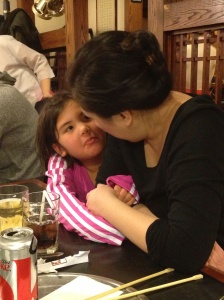
There was love:

IMG_1856

There was laughter. (Nicholas was called upon to judge whose pet was cutest):

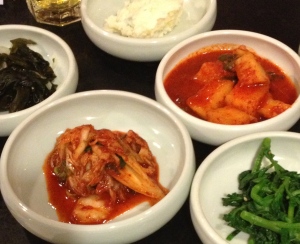
There was kimchi:

IMG_1859And there was…squirrel food acorn jello!

IMG_1858

Other favorite Korean restaurants to try in the Northern Virginia area:

Choong Hwa Won in Annandale.

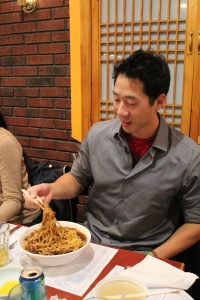
We go here for the jajangmyun (see below) – these are noodles drenched in black soybean sauce. I swear it tastes better than it sounds! In Korea, ordering jajangmyun for delivery is like ordering pizza for delivery in the U.S.

IMG_1049
Han Sung Oak in Falls Church

HeeBeen in Alexandria and Arlington (buffet)

Korshi in Centreville (buffet)

Woo Lae Oak in Vienna (Tyson’s Corner)

Do you have a favorite Korean restaurant near you?

Enhanced by Zemanta

New Year’s Soup

We spent the New Year in Arlington with my parents, my sister, and my cousin Tina.

On New Year’s Eve we had an epic Monopoly game. It may be the first time we’ve ever played an entire game all the way through.

One by one players were knocked out. In the final moments, it was down to my sister and daughter…After some ruthless wheeling and dealing that included making puppy eyes at my sister to induce her to trade her Park Place for some inferior property, and then bankrupting everyone with her hotel on Boardwalk, my daughter emerged as the world’s youngest real estate tycoon and the 2012 Monopoly Champion!

The next day we had traditional Korean New Year’s Soup, or  “Dduk Gook.”

Koreans believe that when you eat a bowl of New Year Soup, it marks another year of your life and you become one year older. The white rice cakes represent purity and possibly the moon (for the lunar new year).

It’s hard to find the ingredients for this soup unless you happen to live near a Korean grocery store, but here’s a recipe for my favorite food of all time:

Korean New Year’s Soup

1 package (about a pound) of dduk (chewy oval rice cakes)

8 cups broth (this can be beef, chicken, anchovy broth, etc.)

4 cloves garlic, minced

2-3 tbsps. soy sauce

2-3 scallions cut into 2 inch long pieces

1/3 lb. lean beef sliced into thin slivers, marinated in soy sauce, sesame oil, pepper and minced garlic and sautéed

4 eggs

Mandu (frozen dumplings)

Salt and pepper

Sesame oil

Toasted seaweed julienned

1. Soak rice cakes in cold water for 20 minutes

2. Heat broth, add garlic, soy sauce, scallions, salt & pepper. Simmer 10 minutes.

3. Add dumplings and rice cakes to broth and simmer until rice cakes are soft, about ten more minutes.

4. Lightly beat eggs, then stir slowly into simmering soup. (As you’ll see in the photo, my mom separated the yolks and whites of eggs and fried them separately to use as garnish).

5. Stir in 1-2 tsps. sesame oil.

6. Ladle into large bowls and garnish with beef and seaweed strips.

“Saehae bok mah nee bah duh sae yo!” (May your New Year be filled with many blessings).
Enhanced by Zemanta

Squirrels Eat Acorns. So Does My Family.

There are certain foods that my kids simply won’t eat. I don’t force them to eat everything I put before them, but I do insist that they have at least one bite before they reject it. Occasionally this backfires on me. Once when my daughter was three, I made her try “just one little bite of butternut squash.” She grudgingly acquiesced and then promptly threw up. Still streaming vomit, she whipped her head around to glare at me accusingly, and with an unmistakable note of triumph in her voice, she said, “SEE?!”IMG_7880

When unfortunate events such as this happen, the food is entered into the special Foods-That-Make-the-Kids-Gag category. My rule for these foods is that while I remove them from regular rotation, I make the kids try at least one teensy, tiny, miniscule bite of them once a year. This strategy has yielded some amazing breakthroughs! One of the foods they used to loathe was potatoes. We tried them in 2006. We tried them in 2007, and then: BINGO! In 2008 potatoes became one of their favorite foods. After years and years of trying, we still haven’t rounded the corner on tomatoes, but they’re on the schedule for summer 2013.

It’s hard for me to feel any great sympathy for my kids when they complain about the food I give them. Butternut squash? Potatoes? Tomatoes? PUH-LEEZE! I’m dealing far more charitably with my kids than my own parents ever did with me when it came to food. If we complained about what was put before us, my normally taciturn dad would bark, “If Mom puts a rock on your plate, YOU EAT IT!” And we did. Every single last bite of tripe, raw liver, or whatever else was being served up that day. We choked down some pretty challenging foods for kids growing up in America.

Between the ages of 5 and 8 I lived deep in the darkest heart of the American sticks, in a sleepy backwater town in Pennsylvania. To put things in perspective, Scranton – now practically a byword for shabby, benighted little townlet – was the glittering big city to our town. Reeking of kimchi and fermented soybeans, we might as well have been Martians when our family of six rolled into this microscopic, blindingly white village with a population of around 5,000 something.

The moment I first appeared on the playground of my new elementary school, the noisy chatter and laughter of children at play abruptly ceased, as if someone had pushed a magic mute button. Feverish whispering closely followed the eerie hush that had suddenly descended upon the playground. Little blond heads leaned in close together as the children conferred with each other in obvious bewilderment and consternation at the appearance of this alien in their midst. Innocently, they tried to work out how my face got so very flat, whether my eyes hurt all the time, or whether one would eventually get used to the pain of having eyes like mine…

I have no word of reproach for those children. During our four years in this town, we worked tirelessly, albeit unwittingly to reinforce our reputation as freakish interlopers. Our idiosyncratic approach to food did much to shape this profile. While our neighbors cultivated neat flower beds with nothing more exotic than the odd rose bush, our front yard burst forth with abundant harvests of bok choy and wild sesame. Our school projects were held together not with Elmer’s Glue, but with homemade glue made of water and rice. We kept a giant red Rubbermaid cooler filled with enough rice to put Elmer’s Glue out of business and end world hunger. Even when my parents embraced some culinary aspect of the culture we were living in, they would tweak it somehow so that it was still nonstandard. We would have salad, but it would be tossed with soy sauce, sesame seeds, and red pepper flakes. We’d have Neopolitan ice cream, but instead of scooping it out, my mom would put the carton on a chopping board, cut away the carton, and then slice up the block of ice cream with her largest butcher knife.

You could probably smell the contents of our refrigerator long before our house came into view. If you were to open the refrigerator, you might find vats of soup with rubbery strands of seaweed floating in murky liquid, pungent dishes of marinated bracken fern shoots, or jars crammed with tiny little salted baby shrimp staring out at you with millions of black unseeing eyes. For years we ate sea cucumbers thinking they were vegetables until my sister watched a movie in biology class and saw the dinner we’d had the night before propelling itself in grotesque slow motion like a gigantic, warty slug across the screen. From that day forward, if one of us asked what a certain dish was and the answer was: “Just eat it,” four forks would instantaneously and simultaneously fall onto the table with a loud clatter.

We began to make a weekly escape from our little town when my dad became the pastor of a Korean congregation, which met in a church on the corner of 76th Street and Broadway in New York City. When people from our town found out that we were voluntarily going to the Son of Sam’s lair they shook their heads in disbelief and real concern. But for us it was a blessed relief to hang around with other dark-haired people who understood that roasted seaweed and dried squid were delicious snack foods.

The heavy price we paid for our furlough was the two and a half hour drive to New York. Every Sunday morning at the crack of dawn we would pile into our light blue Chevy Malibu station wagon and head off to the big city. My two older sisters would occupy the bench seat, while my younger brother and I would roll around like a sack of potatoes in the cargo area. The car was not without amenities. There was a gigantic hole in the rusted out bottom of the car and if you lifted the floor mat, you could watch the highway rushing by. If it got too hot, you could always roll down the windows. It was even equipped with a dual-purpose coffee can that made an admirable puke bucket, and could serve as a toilet in a pinch.

On the way back from church we would break up the journey by stopping off at a grocery store to buy lunch. We would buy a loaf of bread, some salami, yogurt, and pickles. Usually we would sit in the parking lot of the Grand Union dining on this Grand Repast in our chariot of fire. When the weather was good, we would drive a little further to a rest area that had picnic tables. One day we sat at a picnic table somewhere on the interstate in our Sunday best, feasting on pickles and salami like kings and queens. My parents were gazing at the tall oak trees that surrounded us when they had a sudden brainstorm. Before we could lick the pickle juice off our fingers we were hustled over to gather acorns that had fallen from the trees. Travelers did double takes, squirrels glared resentfully as we stooped over to collect acorns, their acorns. Because, as everyone knows, squirrels eat acorns. So do Korean people. These acorns would later be peeled, puverized, and transformed into a tasteless, glistening, gelatinous substance. It’s a lot of effort, really, for not very much at all, and hardly worth it when you factor in the enormous psychological cost of having to steal food from squirrels in plain view of everyone traveling on I-80.

We eventually moved when my parents decided it was time to seek the company of like-minded fellow acorn-eaters in the far more populous and diverse suburbs of Washington, DC. I remember staring out the back window of the old rusted-out Malibu as we drove away, taking a final look at the place that had become our home, despite the intense sense of dislocation and alienation we had felt there for so much of the time. I may even have shed a few tears.

When I tell my kids, who have grown up on such innocuous foods as pasta, chicken nuggets, and pizza about my years in Pennsylvania, I tell them about real hardships and how they humbled, but also strengthened us. If we could make it there, we could make it anywhere, blah, blah, blah-buhty, blah…And let’s get real, kids: Do I make you eat raw organs? Am I dishing up sea slugs? Have I ever once made you eat squirrel jello?! So if Mom puts a tomato on your plate, YOU EAT IT!”

People as Topiary

My husband coined the expression “People as Topiary” to describe the Korean attitude toward perceived imperfections. For Korean people a misplaced freckle might constitute disfigurement. Sadly, I know this from first-hand experience. My mother will scrutinize my face with concern after not seeing me in a while and ask, “Did you always have those freckles under your eye?” She tries to quell the rising note of panic in her voice, but it’s unmistakable…Those freckles (which, yes, I’ve had all my life) are located where tears might be and that is Not Good. Pity the Korean child born with a hairline a millimeter too low over his forehead, for this is an obvious indication that his father is suspect. A nose that is too pointy portends a life of poverty and bad luck. Throw out the prospect of a decent marriage if such a misfortune should befall you — or find yourself a good plastic surgeon.
Korea is now the country with the highest number of plastic surgeries per capita. An astonishing one in five Korean women has plastic surgery, according to a market research survey done in 2009. The most popular procedure is double-eyelid surgery, which creates a crease in the lids. Even Roh, Moo-Hyun, the former president who committed suicide in 2009, acknowledged having had an eyelid job during his term in office.

When I was in high school a lemur-eyed woman in my dad’s Korean congregation would harangue me every Sunday during coffee hour to get this procedure done. I would try to inconspicuously skulk off to a corner clutching my donut, but she’d always seek me out and bray, “Honey, you should get your eyes done so you look pretty like me!” Years later, I got my double eyelids, not through plastic surgery, but the good old-fashioned way: droopy, aging skin. Lucky me.

Currently, the “Flower boy” look is the Korean ideal of male perfection. “Flower boys” are waif-like men with delicate, “pretty” features and flawless skin, often enhanced with makeup. In pursuit of this look, South Korean men spend staggering sums of money on skin products and makeup – more than any other male population around the world. If you’re not born with it, you can buy it.

But there’s not much you can do about the most disastrous misfortune of all, which is to be born without native intelligence. Not that people don’t try. There is a plethora of plastic surgery clinics in Korea, but there are even more after school cram schools (hagwan). Parents choose where to live based on how convenient the neighborhood is to a good hagwan. Plastic surgery, in fact, is sometimes offered as a reward for good grades. The ultimate goal of all this cramming is to earn a spot in an elite university, because to graduate with a pedigree is to ensure one’s place in society.

I think this is why I find the Psy (Park, Jae-sang) phenomenon so entertaining. Much has been written about Psy’s average looks. He has called himself “a chubby guy” and he doesn’t appear to have had any “work” done. For the K-pop stars who have flirted at the edges of the kind of global fame he has enjoyed, looks are as important as musical ability. I think it’s safe to assume that a substantial percentage of these K-pop idols have been pruned, lopped, shaped and sheared to achieve the undernourished, saucer-eyed, elfin look du jour.

Psy’s father, the head of a large firm, sent his son to Boston University to study business so that he could return to Korea and take over the company. Instead, Psy dropped out of Boston University, enrolled in Berklee College of Music, and then dropped out of that school as well. You just know his parents’ innards were twisting into tight ulcerous knots when he returned to Korea without a degree. What a bitter pill it must have been when instead of taking over the family business, he became a controversial musician and was busted for pot. But one of the more interesting Karmic stories that emerged when Psy became so wildly popular that United Nations Secretary General Ban, Ki-Moon ceded to him the title of  “most famous Korean person in the world,” was that the value of his father’s company soared.

There is something truly beautiful in the fact that Psy has achieved fame and fortune, all without being one of these:

Enhanced by Zemanta

The Wedding

Image

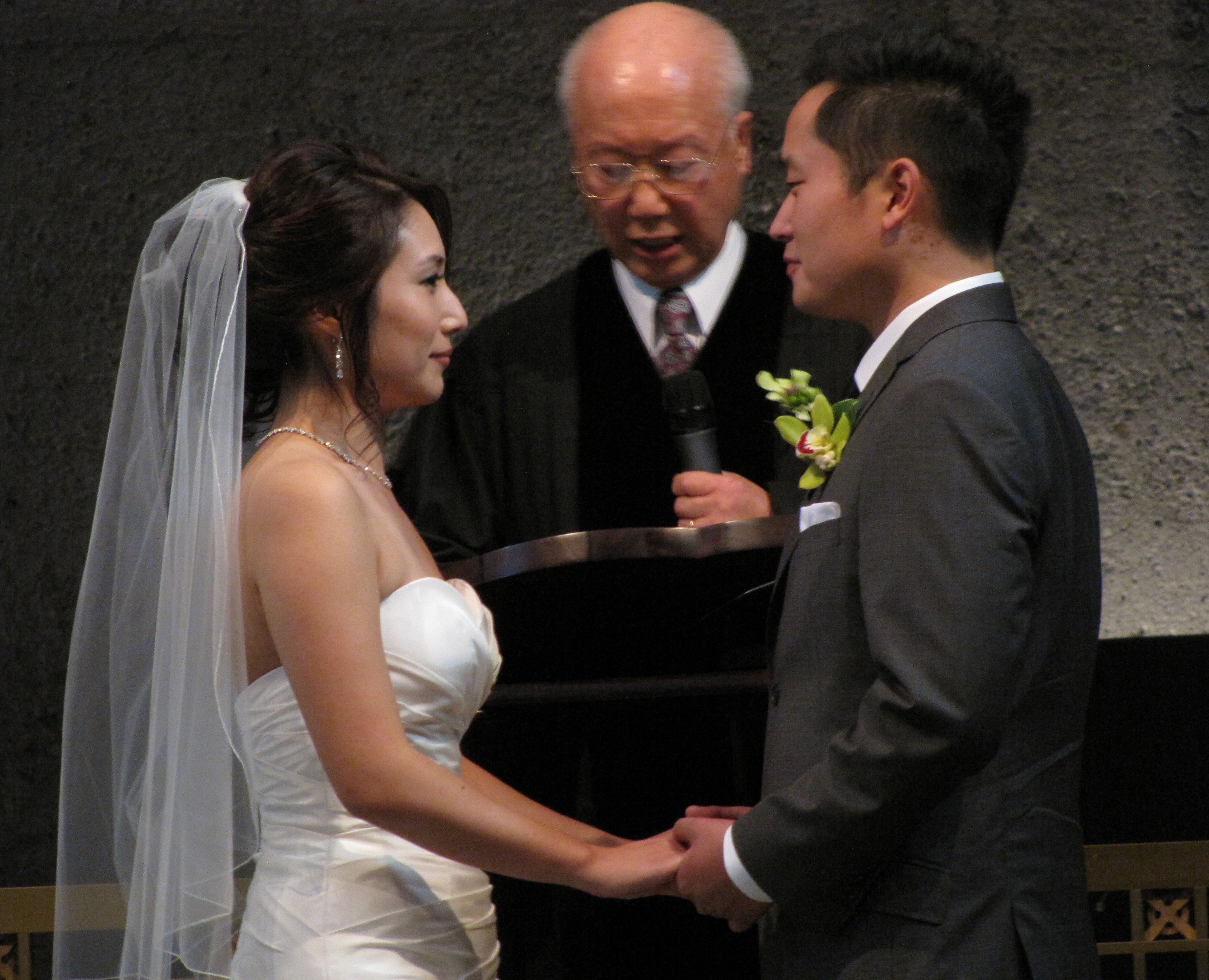
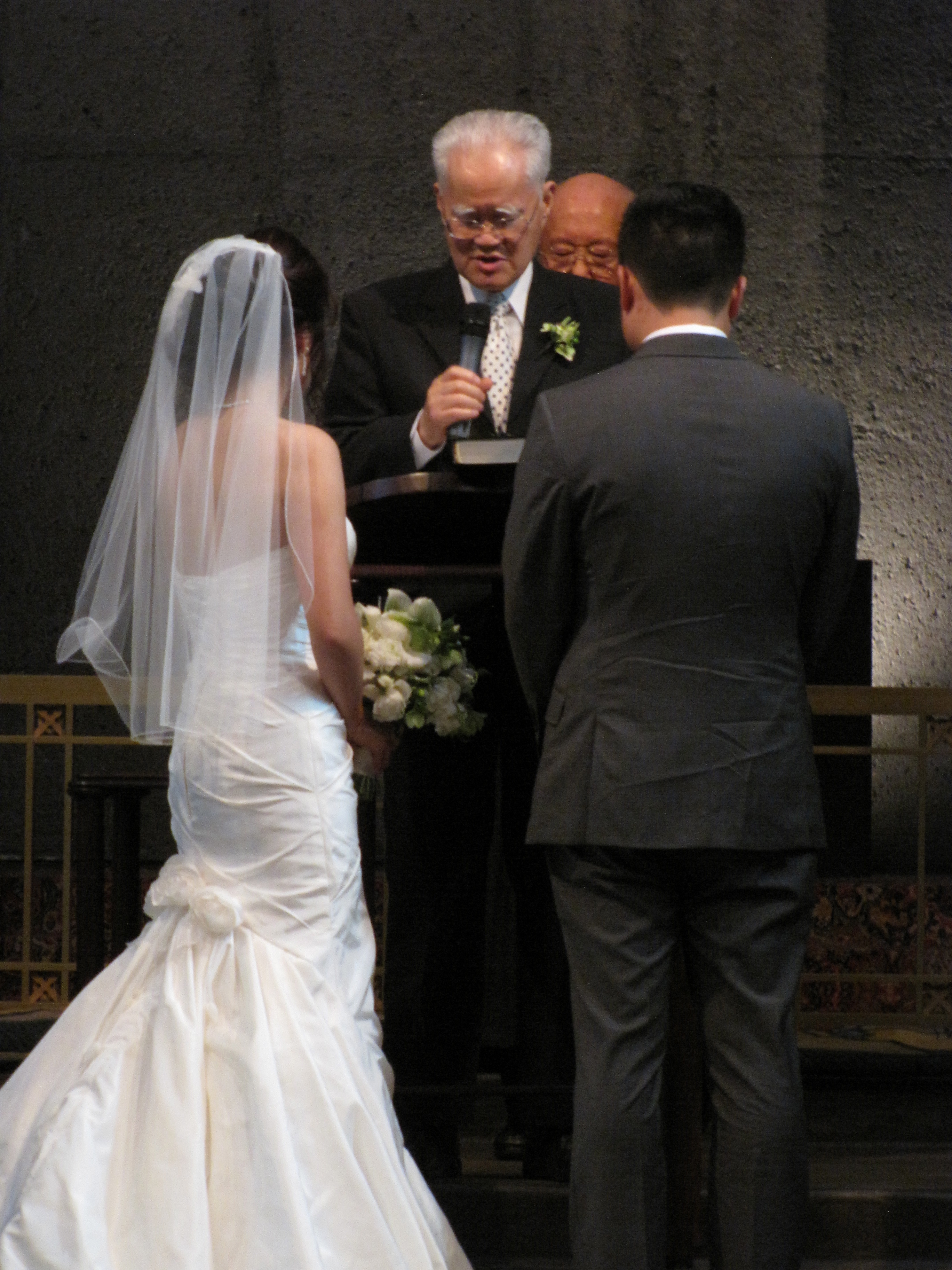
The bride and groomImage

My dad gave the benedictory prayer.Image

It was the perfect day for a wedding in beautiful Belvedere. I love how happy the new couple looks in this photo as they leave the church.Image

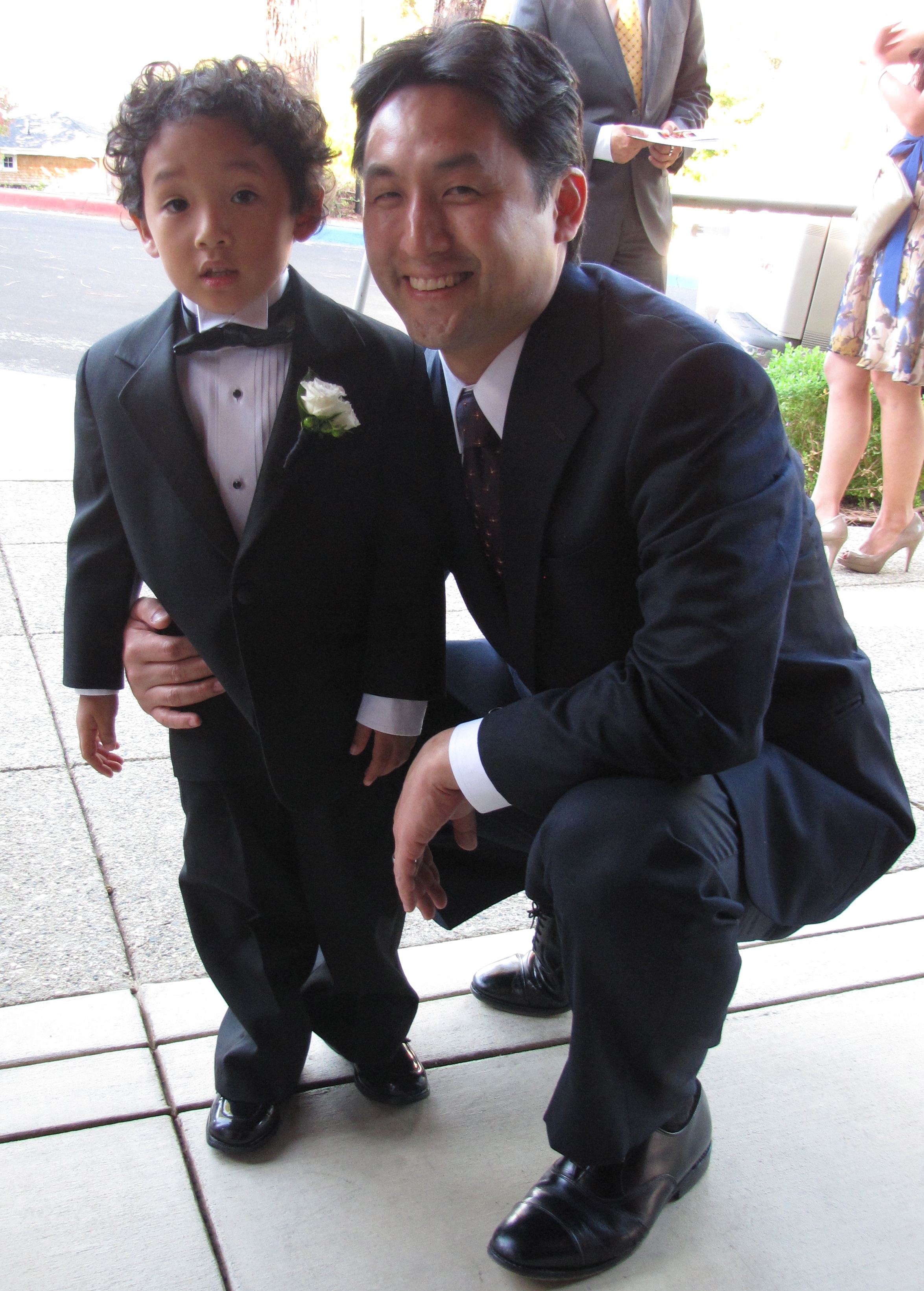
The cutie-pie ringbearer with his dad, my cousin.Image

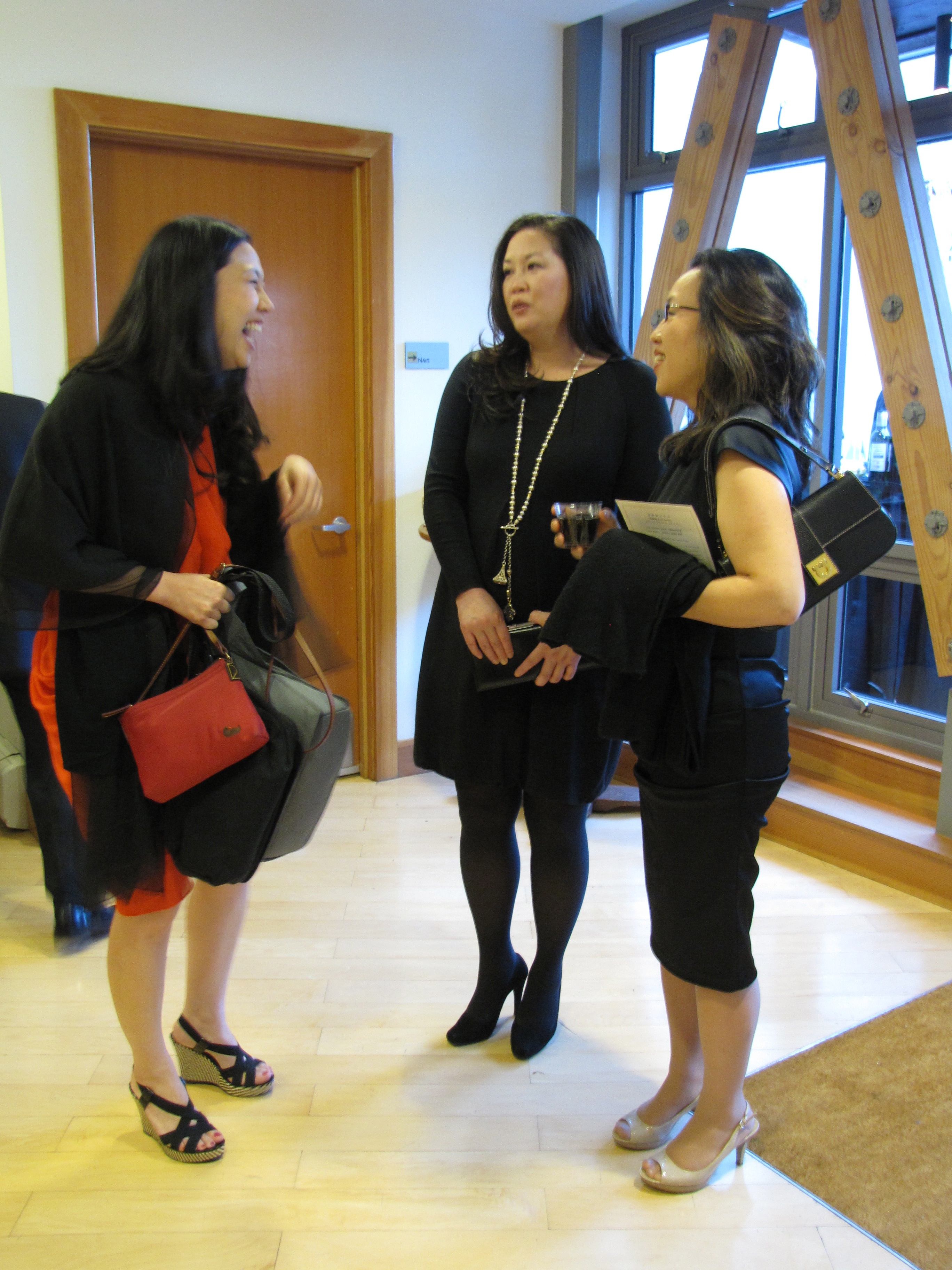
It was great to see so many of my dear cousins. Image

That’s my sister in the middle!

Image

I’ve got a zillion cousins…Image

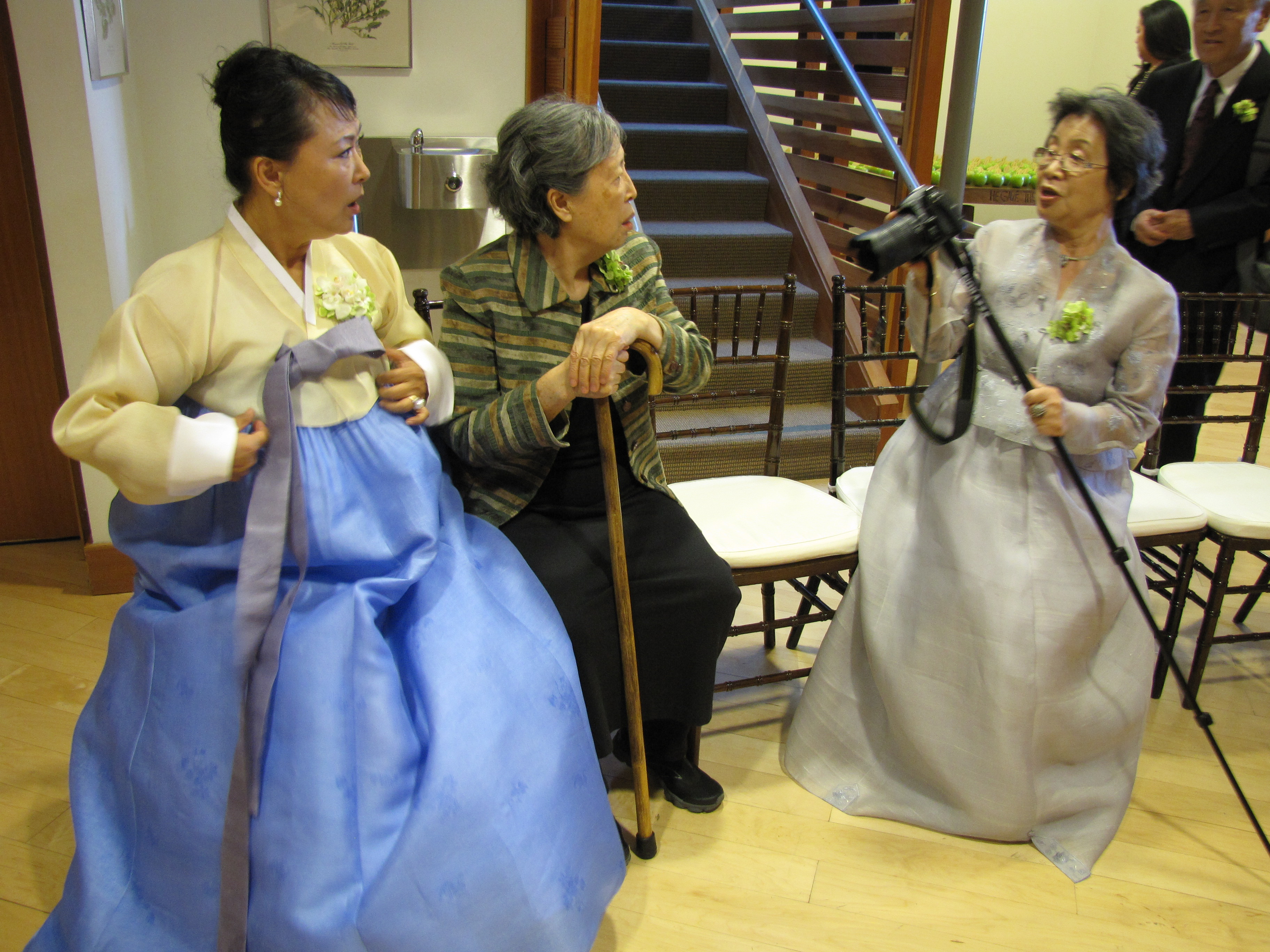
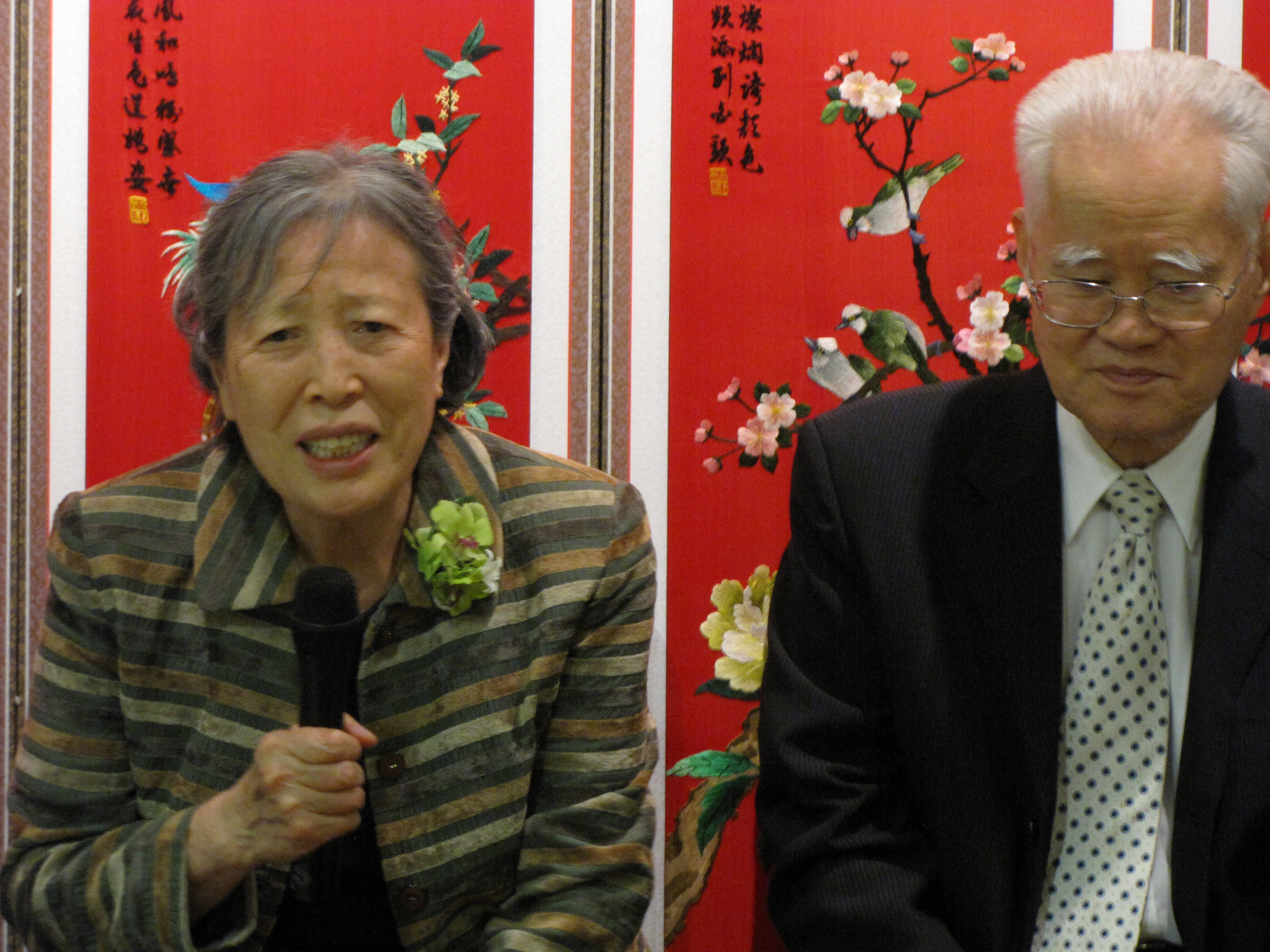
…and aunts. The aunt to the left of my mother is the mother of the groom. See my mother’s sister on the right? The delicate and distinguished lady in the grey hanbok with the freakishly large camera apparatus? We had knock-down drag-out beat downs all night long for camera angles. (It was no contest. She won every time, of course. Every. Single. Time.).

Image

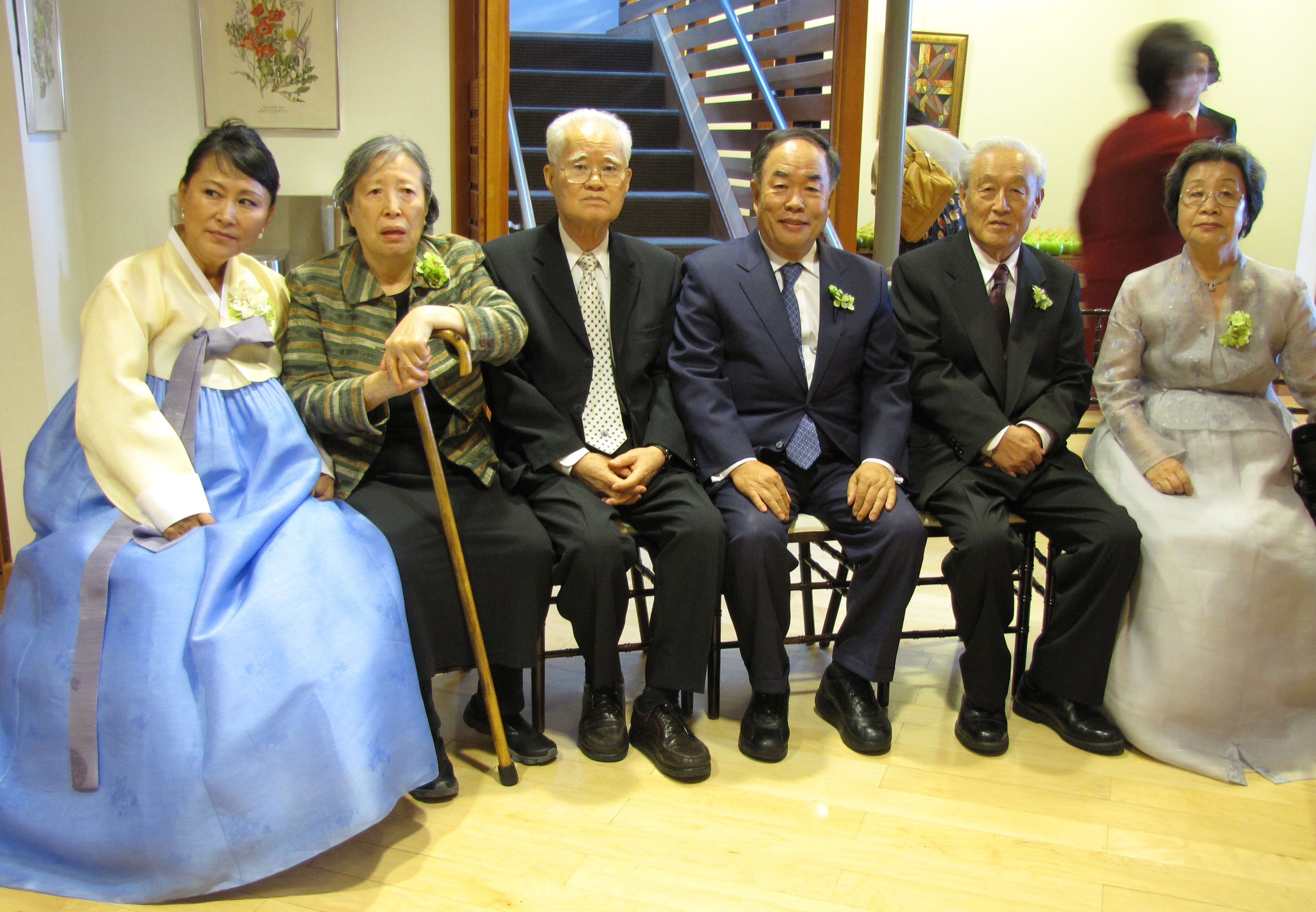
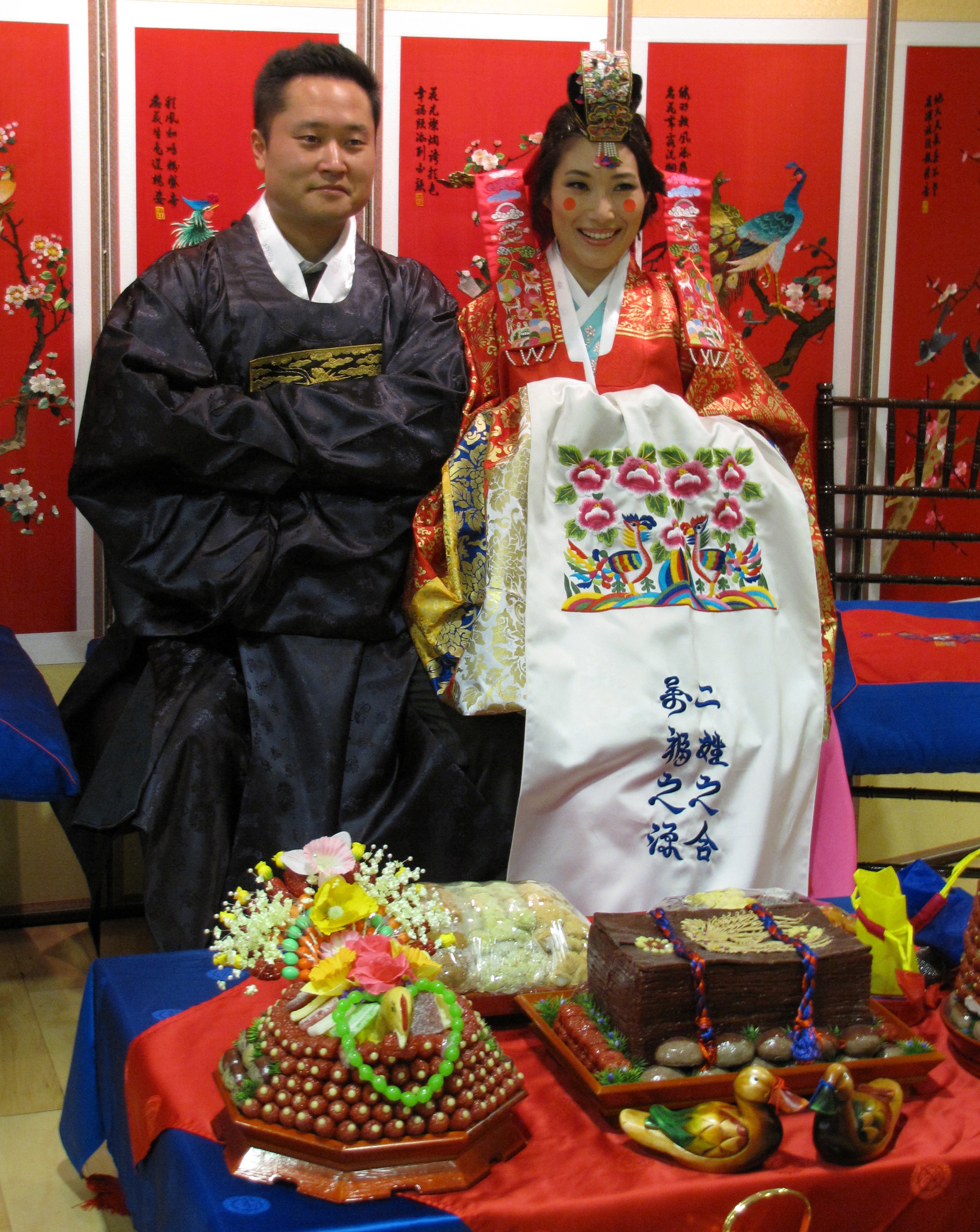
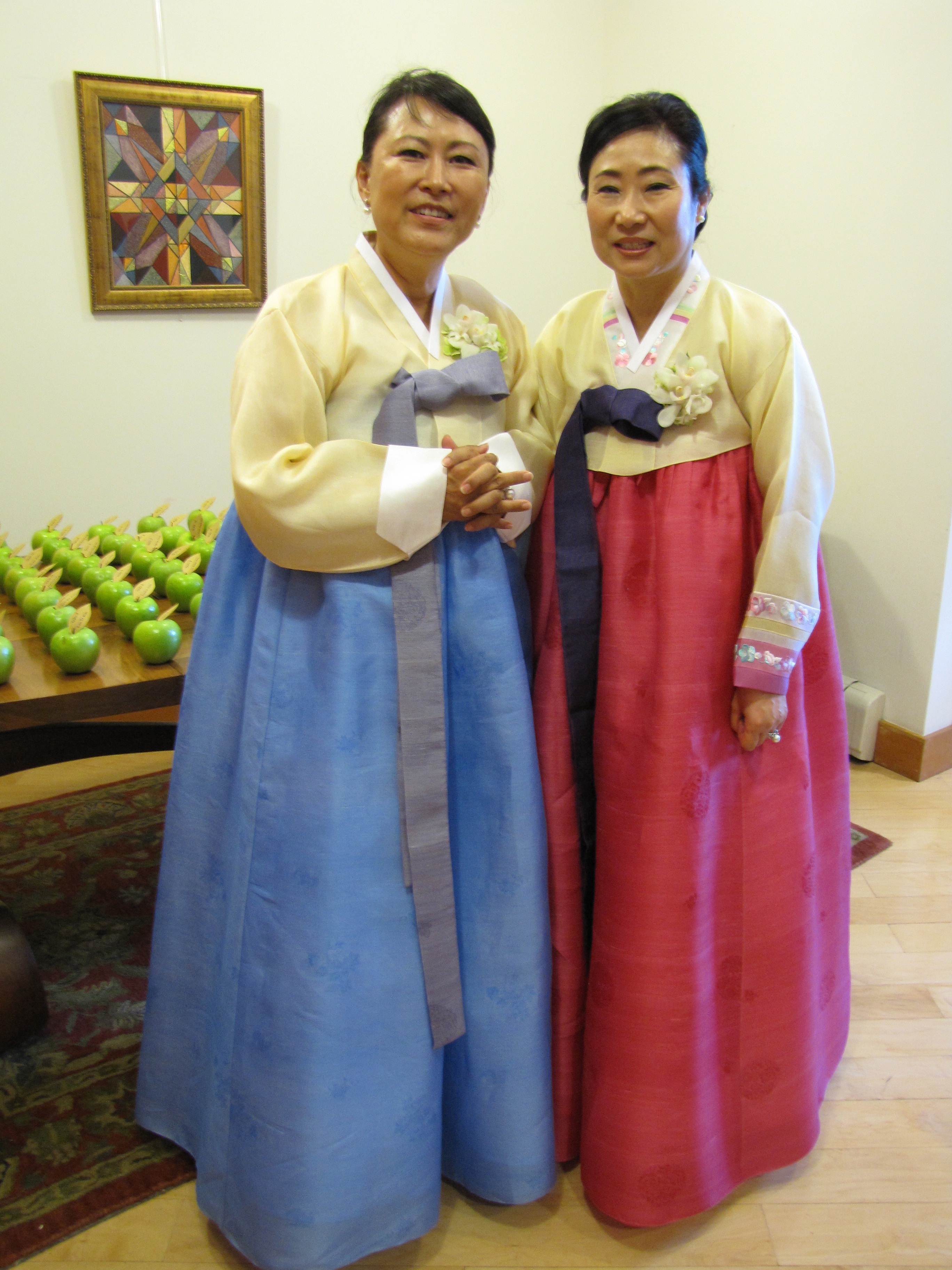
The mother of the groom wears a blue hanbok. The mother of the bride wears pink.Image

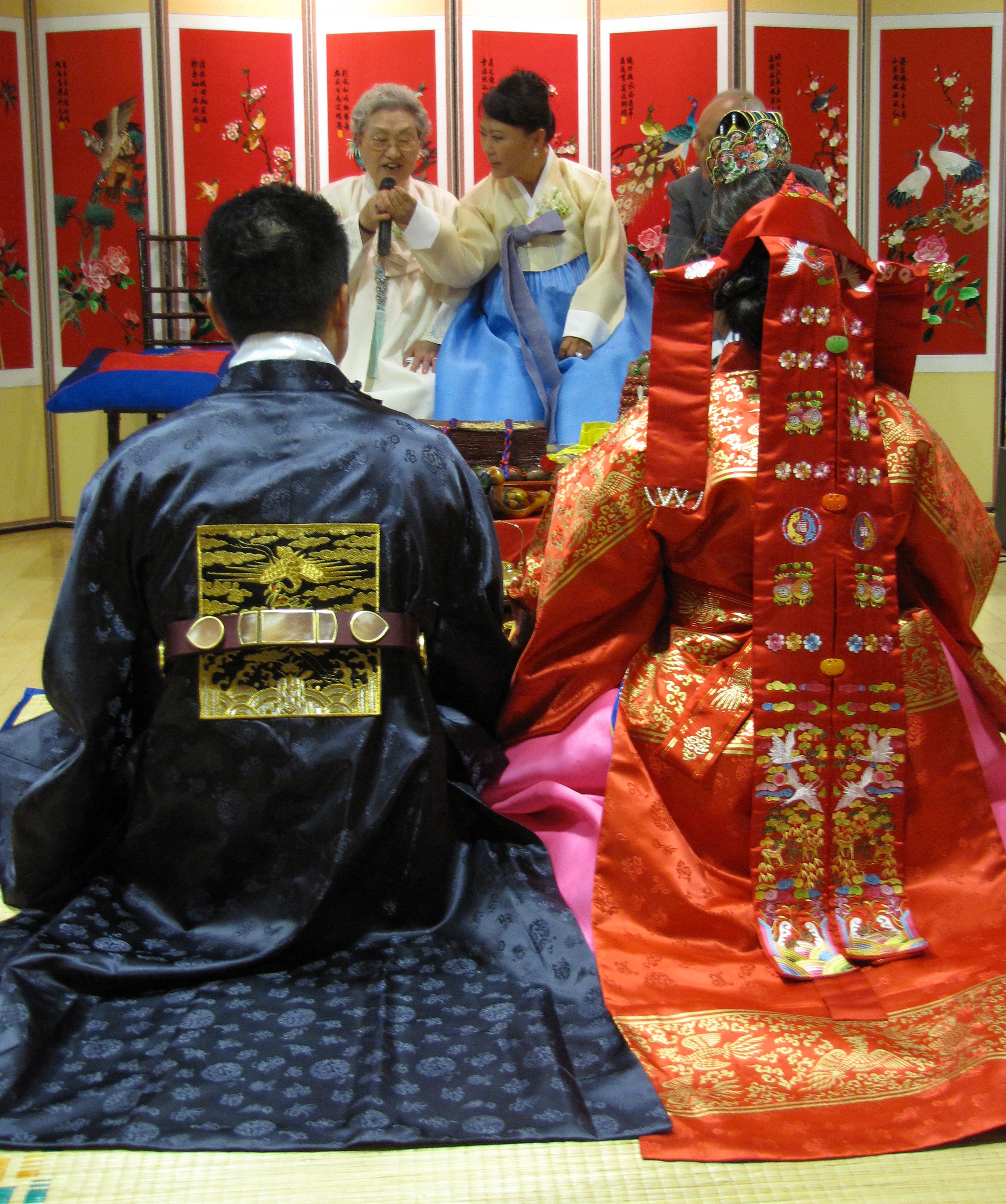
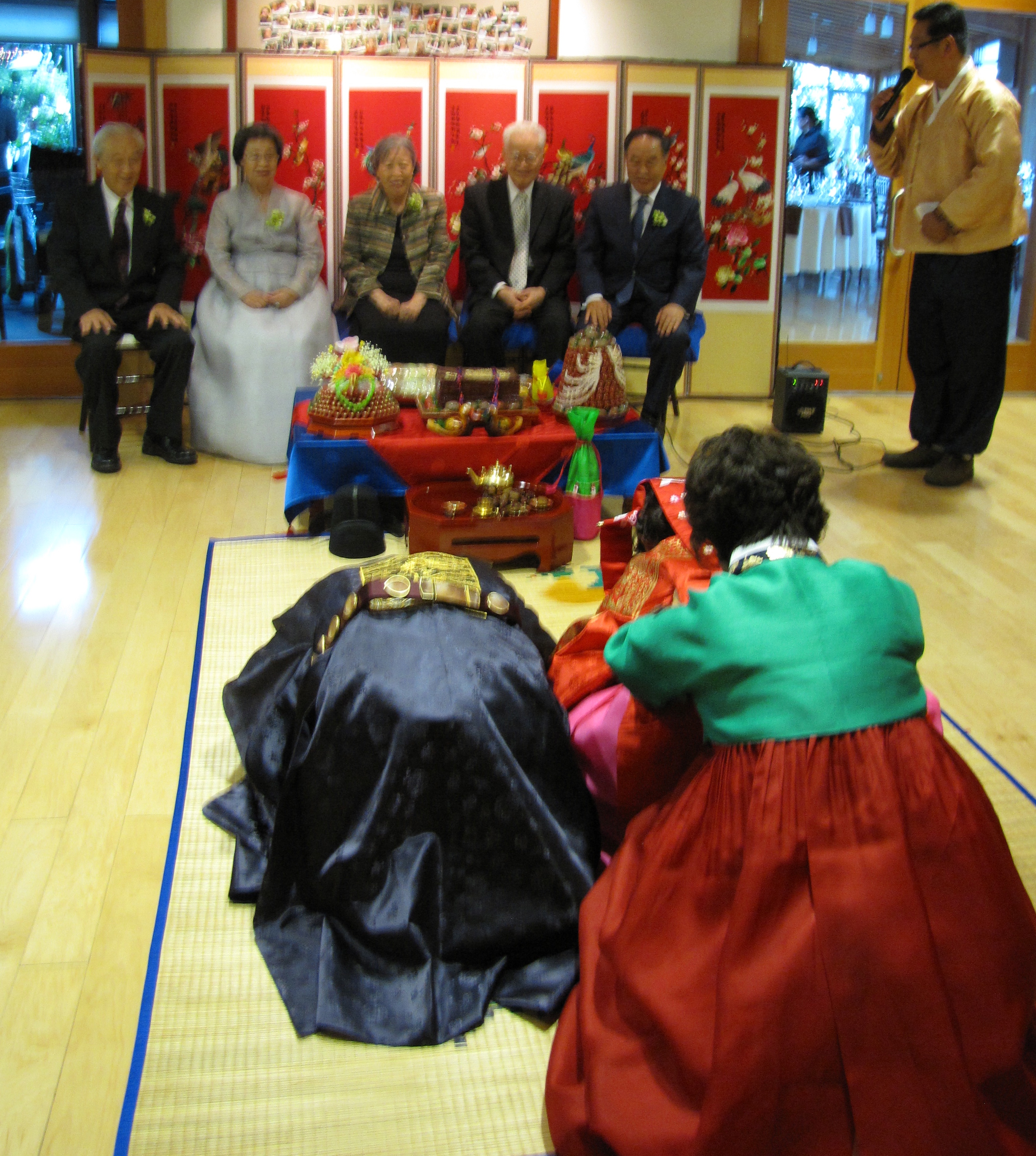
And now for the “pae baek,” the traditional Korean wedding ceremony…The couple offers tea or wine and chestnuts and dates to their elders. Image

The elders offer their blessings and impart words of wisdom. They also slip them wads of cash in little white envelopes!Image

The elders throw chestnuts and dates and the couple tries to catch as many as they can in a cloth. The chestnuts represent the boys and the dates represent the girls they’ll have. The bride caught 15 chestnuts and 8 dates. I heard a Korean ajumma say, “You better get busy!!!”Image

Another set of elders (the uncles and aunties) take their turn. They receive their bow.Image

My mom tells them, “Don’t fight…And just have two boys and two girls.”(Really? Is that all)?!Image

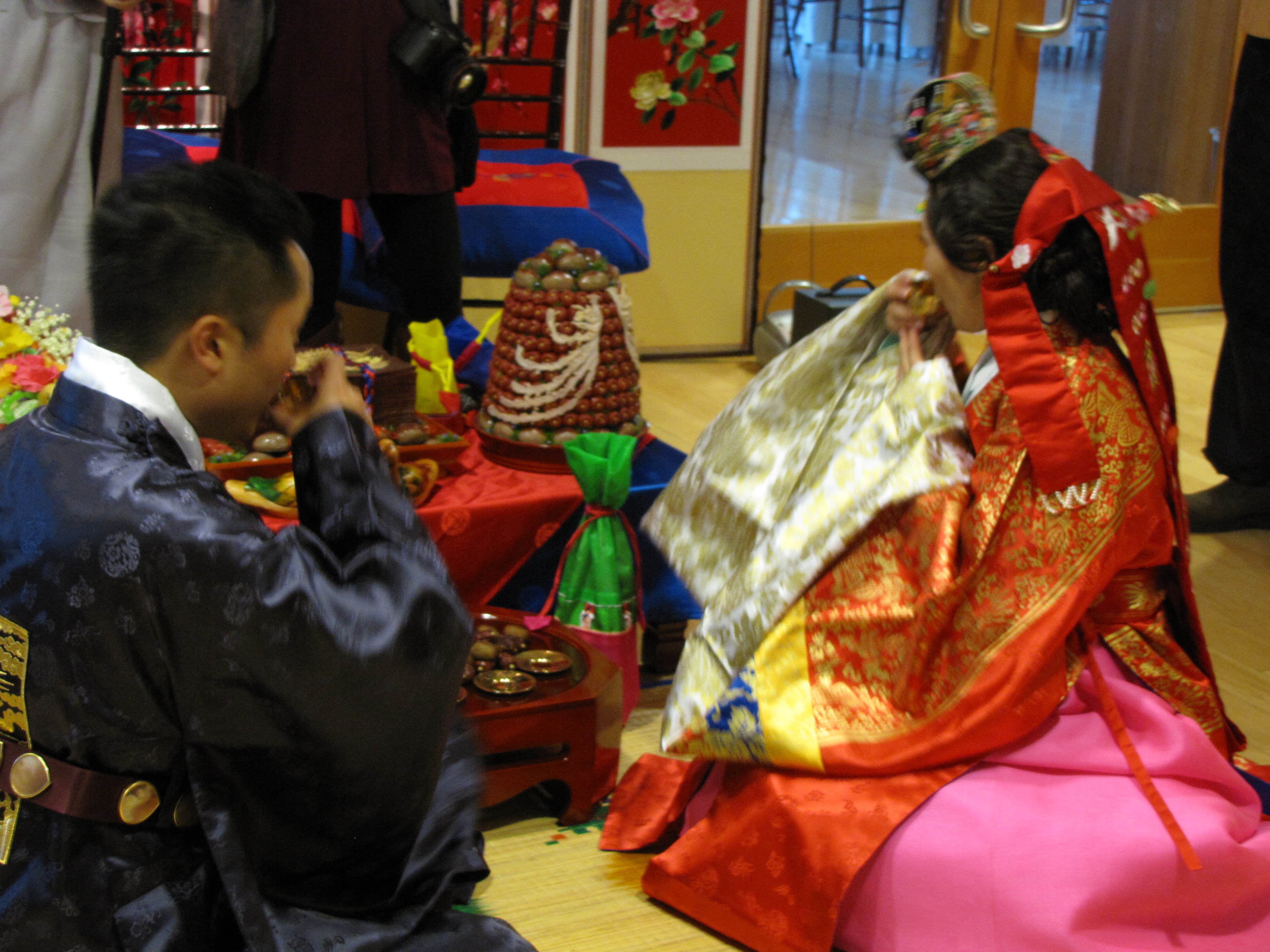
The couple shares a drink…Image

and a date!Image

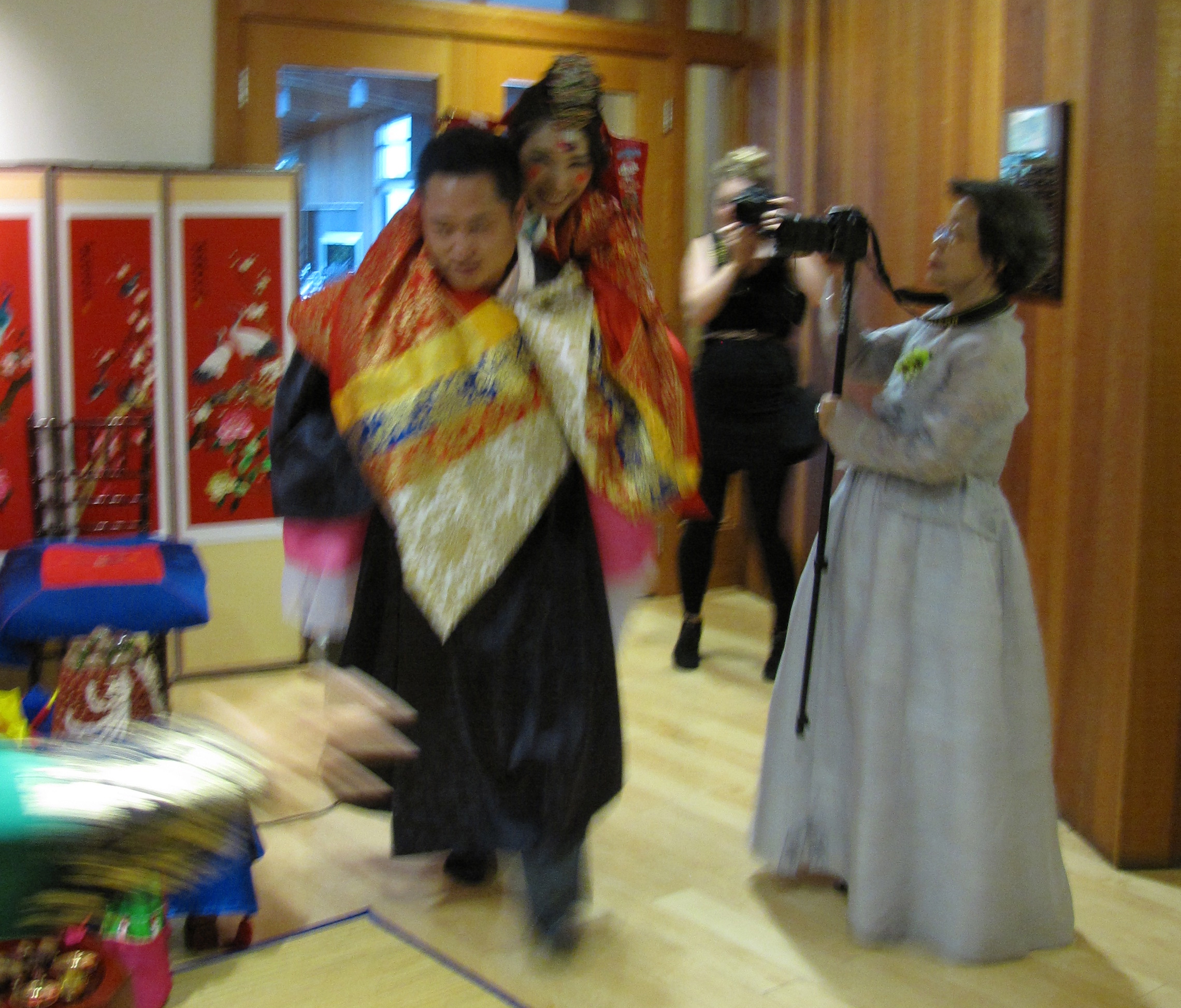
The groom gives the bride a piggyback ride around the table. (There’s my auntie with her gigantic camera)! Sometimes the groom will also give a piggyback ride to his mother and maybe even his grandmother as a symbol that he will be responsible for all of them. Image

The wooden ducks on the table represent faithfulness, because ducks mate for life.ImageImage

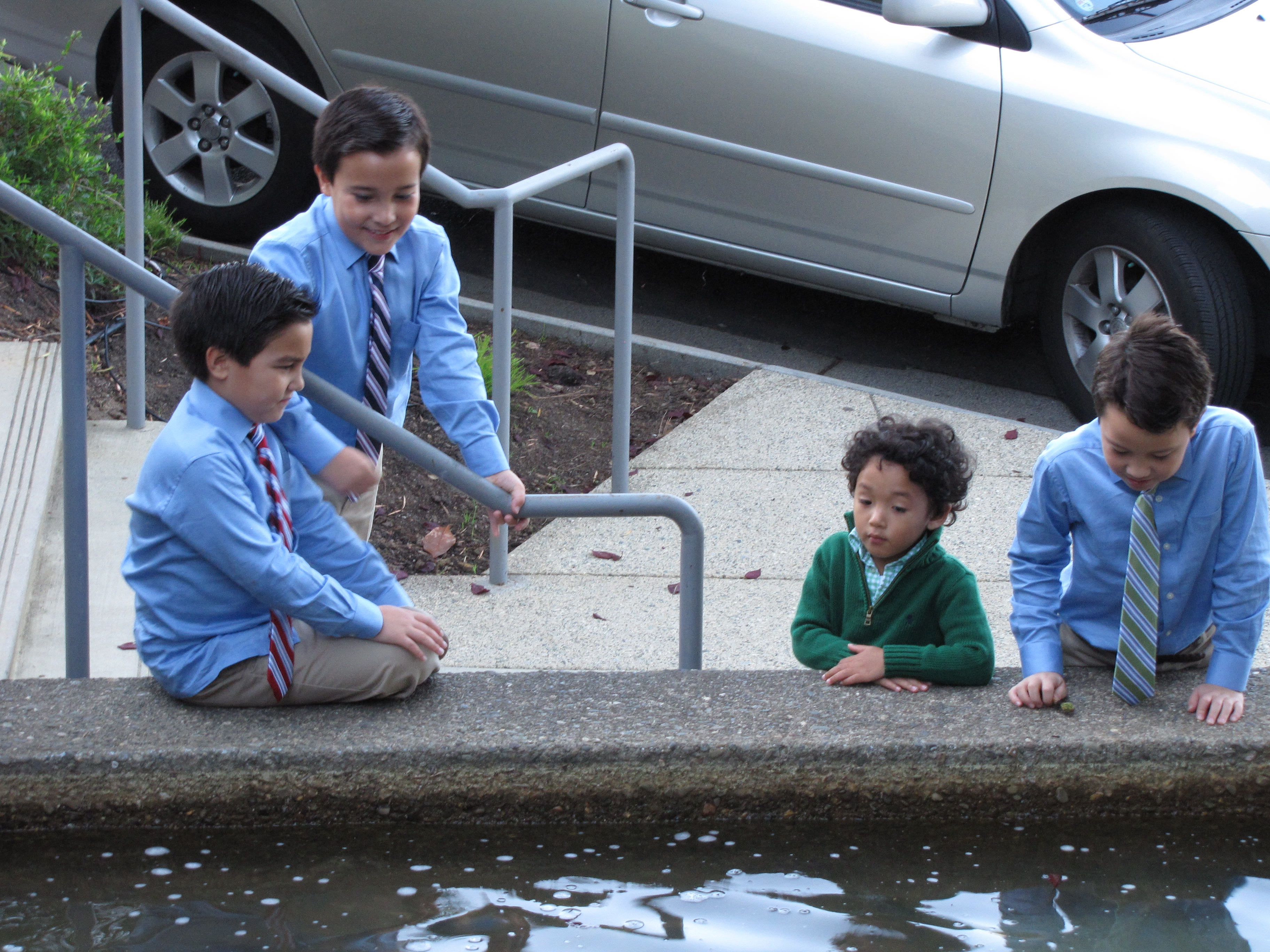
My little nephews hung out with my cousin’s son during the cocktail hour:

Image

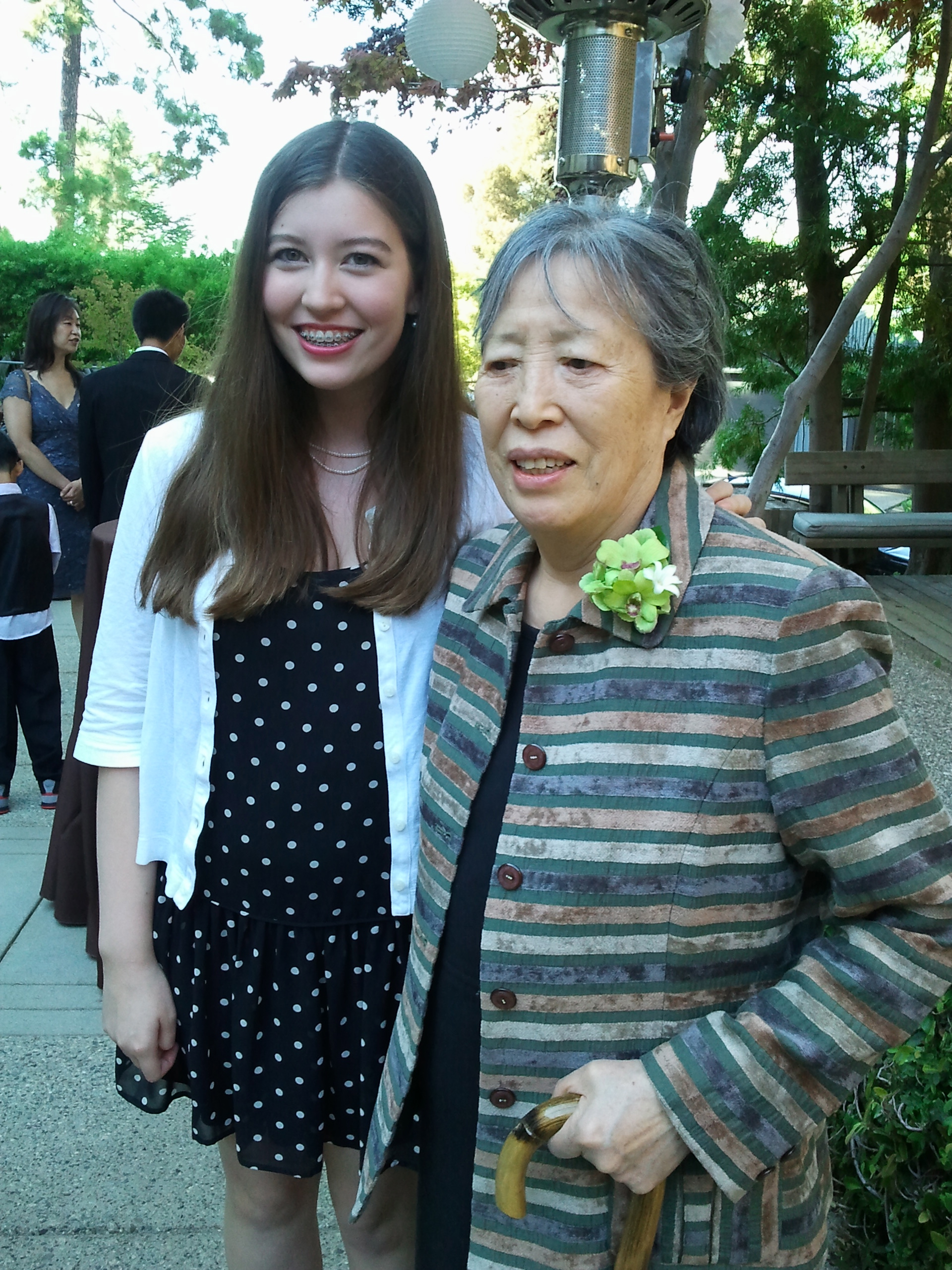
My niece and my mom…

And then it was time for the reception:

Image

My nephew “R”:  “Call me!”

Image

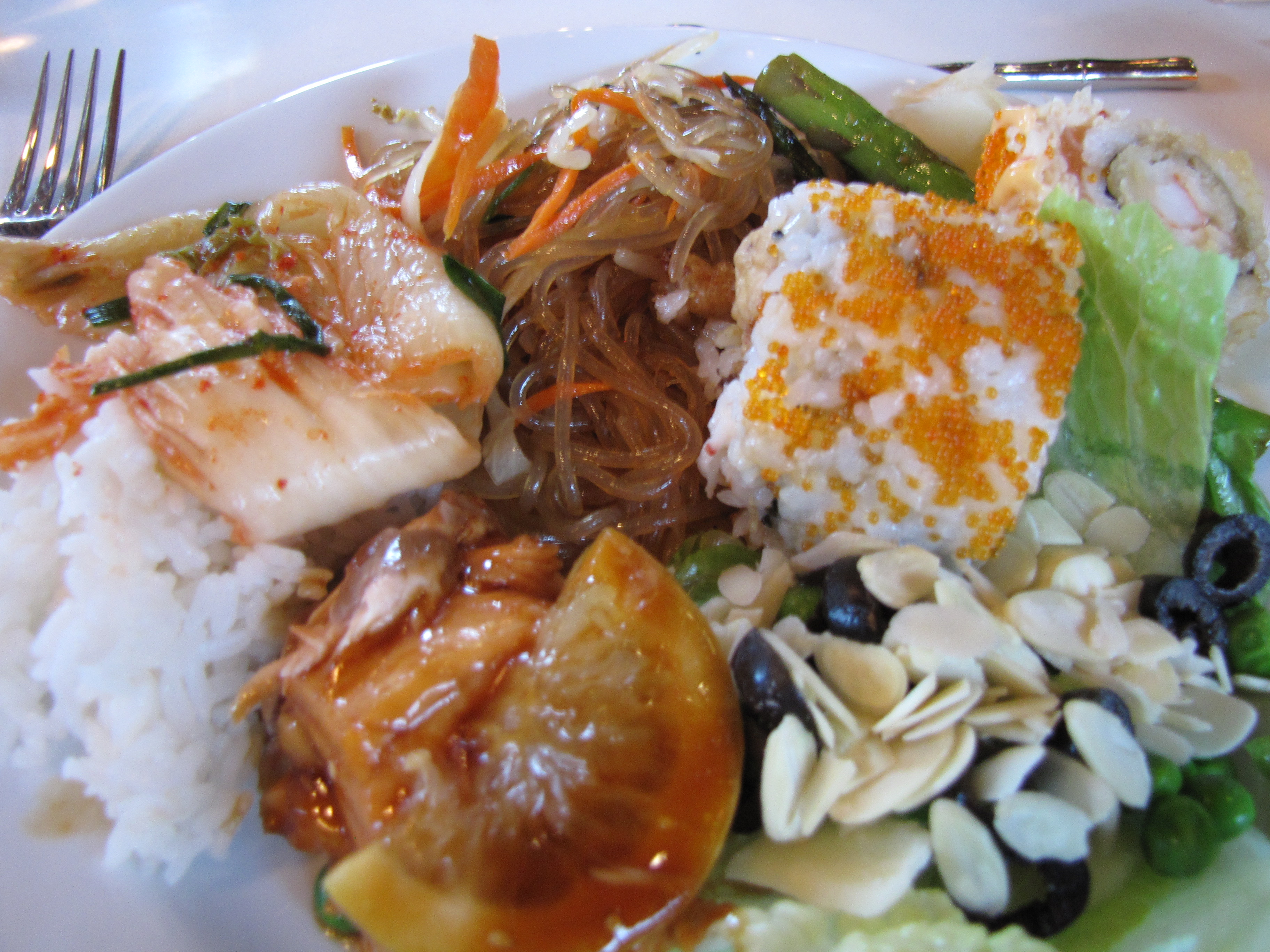
Korean wedding buffet. Kimchi, jap jae, sushi, rice…Image

ImageImage

It was lovely.