Happy, Pt. 2

I am descended from a long line of forbears who, well, forbore. My maternal grandfather survived a massacre of Christians that wiped out three generations of his family in one day. During the Japanese occupation, he was repeatedly arrested and tortured. In his old age, long after he had incontestably earned the right to snooze all day long in a comfy armchair with his mouth hanging open, he would rise before dawn every single day to scale a mountain. He would scramble back down that mountain, plunge himself into a bath with large blocks of ice floating in it, and then head off to carry on the business of running a university.

My maternal grandmother was also a survivor of war, occupation, and their attendant horrors and privations. She came through the experience as a formidable warrior. She made no secret of her reverence for the Spartan civilization. You know, those militaristic people who would leave sickly infants to die of exposure on the sides of mountains and who would starve and literally whip the small children who passed muster into shape to toughen them up to be soldiers? Yes, those were her kind of people.

My paternal grandfather died young, leaving my grandmother to struggle for survival. Some of her children succumbed to disease and malnutrition. It’s entirely understandable then, that having passed through the crucible of unimaginable hardships, my dad would emerge on the other side to preach the gospel of “Where in the Bible does it say you have to be happy?” on Christmas Eve.

Less comprehensible is how I turned out, given my genetic inheritance. The only explanation I can think of is that the gene for stoicism must have skipped a generation. If you’ve been reading along, you already know that the proximity of a spider is enough to destroy my happiness, (though in my defense, it was a shockingly big, stripy, furry one). My latest tragedy is that the internet has been erratic and agonizingly slow at my house. I’m telling you, it’s been making me gnash my teeth in despair. I can’t pretend to be like my steely ancestors. Me? I yearn for happiness like a lovelorn adolescent. I stalk it like a craven addict looking for her next hit. When I find it, I greedily clutch it to my chest and swat away anyone or anything that tries to snatch it out of my white-knuckled fists.

Just as it doesn’t take much to destroy my happiness, it doesn’t take much to make me happy either. For me, it can sometimes be merely the successful avoidance of discomfort. For example, every time I stay home while the rest of my family goes hiking or camping=pure bliss! (Pretend I’m homeless by sleeping in a tent on the cold hard ground with bugs and no running water or AC when I could be in lounging in the comfort of my own bed watching trashy reality TV? Puh-leeze! That would be messed up)! Sometimes I find happiness in those sublime everyday moments of grace, such as when I finally extract a piece of corn that’s been stuck in my teeth forever, or when I experience the satisfaction of  peeling away a really long strip of dead skin from my heel. (What? Don’t even try to tell me that doesn’t make you happy, too)!

And even though my claims on happiness are really quite modest, every once in a while, it will flip me the bird and flounce off like a faithless strumpet. I’m left feeling bereft and hopeless…It’s in those dark moments, that I have to exert a little more effort to find a way to drag happiness back into my corner. And here, at long last, is where I’m going with this long and meandering, multi-part post…What are your strategies for finding happiness? I’ll tell you mine, if you tell me yours. More on this tomorrow.

The Caterpillar

After a two-week hiatus, I’ll start publishing new posts again tomorrow. Here’s the last of my favorite old posts. I’m ending with this one because it encapsulates what I want to do with this blog…that is:  to illuminate the extraordinary ordinary moments that add up to a lifetime. Thank you so much for reading and for your comments!

Last Friday morning I was in a big fat rush. It was going to be a busier day than usual at work. I woke up stressed out about all the documents I needed to crank out, the emails I had to answer, and the presentation I was going to give that still needed fine-tuning. I wanted to get the kids to our neighbor’s house early so I could get to work.

To my frustration, instead of letting me drive them there, my children begged to be allowed to walk. I didn’t have the heart to say no, but I warned them that they would need to hurry. I drove the short distance myself, passing them as they walked. I parked the car at our neighbor’s house and waited for them. While I stood there waiting, acorns turned into mighty oaks, mountains eroded into plains, and species evolved.

I was reminded of my son’s first tee-ball experience. During one of his games I was standing behind the fence right behind his two coaches. Whenever it was time for the two teams to switch sides, they would tuck their chaw into one cheek with their tongues so they could yell out, “HUSTLE, BOYS! COME ON! HUSTLE! HUSTLE! HUSTLE!” as they stood there with their arms crossed over their beer bellies. All the little four year olds would run across the field as fast as their little legs could carry them. My son would lope along at a gentle pace a few yards behind the pack. At one point, one of the coaches turned to the other with a look of disgust and spat, “That boy don’t know the meaning of hustle.”

As I waited by the car in front of our neighbor’s house I could see my children slowly ambling along the road and thought, “Come on kids, hustle, hustle, hustle!” As if in perverse response to my mental plea, I saw them slow down instead, and then drop to the ground to inspect something.

“Come here, Mom! You have to take a picture of this!” my son called to me.

For a second I thought about scolding them and reminding them that I was in a hurry. For some reason, (OK, probably because my son so adroitly played to my photo obsession), I grabbed my camera and walked back to where they were.

To be honest, I was kind of disappointed at first when I realized they were just looking at a caterpillar. But they were both so completely entranced that I crouched down to look at it myself. I could see their point. The translucent lime green skin! The perfectly segmented body! Those curious speckles!

The caterpillar was a cosmic gift. For a moment, the mere fact of its existence arrested time, that most precious commodity of all, and we were wonderstruck. Oh, to always have the open heart and reverent eyes of a child…to slow down enough to see the abundant miracles around us and to know instinctively that appreciation of these wonders must always take precedence over lesser concerns.

My family steals acorns from squirrels.

There are certain foods that my kids simply won’t eat. I don’t force them to eat everything I put before them, but I do insist that they have at least one bite before they reject it. Occasionally this backfires on me. Once when Tatiana was three, I made her try “just one little bite of butternut squash.” She grudgingly acquiesced and then promptly threw up. Still streaming vomit, she whipped her head around to glare at me accusingly, and with an unmistakable note of triumph in her voice, she said, “SEE?!”

IMG_7880

When unfortunate events such as this happen, the food is entered into the special Foods-That-Make-the-Kids-Gag category. My rule for these foods is that while I remove them from regular rotation, I make the kids try at least one teensy, tiny, miniscule bite of them once a year. This strategy has yielded some amazing breakthroughs! One of the foods they used to loathe was potatoes. We tried them in 2006. We tried them in 2007, and then: BINGO! In 2008 potatoes became one of their favorite foods. After years and years of trying, we still haven’t rounded the corner on tomatoes, but they’re on the schedule for summer 2013.

It’s hard for me to feel any great sympathy for my kids when they complain about the food I give them. Butternut squash? Potatoes? Tomatoes? PUH-LEEZE! I’m dealing far more charitably with my kids than my own parents ever did with me when it came to food. If we complained about what was put before us, my normally taciturn dad would bark, “If Mom puts a rock on your plate, YOU EAT IT!” And we did. Every single last bite of tripe, raw liver, or whatever else was being served up that day. We choked down some pretty challenging foods for kids growing up in America.

Between the ages of 5 and 8 I lived deep in the darkest heart of the American sticks, in a sleepy backwater town in Pennsylvania. To put things in perspective, Scranton – now practically a byword for shabby, benighted little townlet – was the glittering big city to our town. Reeking of kimchi and fermented soybeans, we might as well have been Martians when our family of six rolled into this microscopic, blindingly white village with a population of around 5,000 something.

The moment I first appeared on the playground of my new elementary school, the noisy chatter and laughter of children at play abruptly ceased, as if someone had pushed a magic mute button. Feverish whispering closely followed the eerie hush that had suddenly descended upon the playground. Little blond heads leaned in close together as the children conferred with each other in obvious bewilderment and consternation at the appearance of this alien in their midst. Innocently, they tried to work out how my face got so very flat, whether my eyes hurt all the time, or whether one would eventually get used to the pain of having eyes like mine…

I have no word of reproach for those children. During our four years in this town, we worked tirelessly, albeit unwittingly, to reinforce our reputation as freakish interlopers. Our idiosyncratic approach to food did much to shape this profile. While our neighbors cultivated neat flower beds with nothing more exotic than the odd rose bush, our front yard burst forth with abundant harvests of bok choy and wild sesame. Our school projects were held together not with Elmer’s Glue, but with homemade glue made of water and rice. We kept a giant red Rubbermaid cooler filled with enough rice to put Elmer’s Glue out of business and end world hunger. Even when my parents embraced some culinary aspect of the culture we were living in, they would tweak it somehow so that it was still nonstandard. We would have salad, but it would be tossed with soy sauce, sesame seeds, and red pepper flakes. We’d have Neopolitan ice cream, but instead of scooping it out, my mom would put the carton on a chopping board, cut away the carton, and then slice up the block of ice cream with her largest butcher knife.

You could probably smell the contents of our refrigerator long before our house came into view. If you were to open the refrigerator, you might find vats of soup with rubbery strands of seaweed floating in murky liquid, pungent dishes of marinated bracken fern shoots, or jars crammed with tiny little salted baby shrimp staring out at you with millions of black unseeing eyes. For years we ate sea cucumbers thinking they were vegetables until my sister watched a movie in biology class and saw the dinner we’d had the night before propelling itself in grotesque slow motion like a gigantic, warty slug across the screen. From that day forward, if one of us asked what a certain dish was and the answer was: “Just eat it,” four forks would instantaneously and simultaneously fall onto the table with a loud clatter.

We began to make a weekly escape from our little town when my dad became the pastor of a Korean congregation, which met in a church on the corner of 76th Street and Broadway in New York City. When people from our town found out that we were voluntarily going to the Son of Sam’s lair they shook their heads in disbelief and real concern. But for us it was a blessed relief to hang around with other dark-haired people who understood that roasted seaweed and dried squid were delicious snack foods.

The heavy price we paid for our furlough was the two and a half hour drive to New York. Every Sunday morning at the crack of dawn we would pile into our light blue Chevy Malibu station wagon and head off to the big city. My two older sisters would occupy the bench seat, while my younger brother and I would roll around like a sack of potatoes in the cargo area. The car was not without amenities. There was a gigantic hole in the rusted out bottom of the car and if you lifted the floor mat, you could watch the highway rushing by. If it got too hot, you could always roll down the windows. It was even equipped with a dual-purpose coffee can that made an admirable puke bucket, and could serve as a toilet in a pinch.

On the way back from church we would break up the journey by stopping off at a grocery store to buy lunch. We would buy a loaf of bread, some salami, yogurt, and pickles. Usually we would sit in the parking lot of the Grand Union dining on this Grand Repast in our chariot of fire. When the weather was good, we would drive a little further to a rest area that had picnic tables. One day we sat at a picnic table somewhere on the interstate in our Sunday best, feasting on pickles and salami like kings and queens. My parents were gazing at the tall oak trees that surrounded us when they had a sudden brainstorm. Before we could lick the pickle juice off our fingers we were hustled over to gather acorns that had fallen from the trees. Travelers did double takes, squirrels glared resentfully as we stooped over to collect acorns, their acorns. Because, as everyone knows, squirrels eat acorns. So do Korean people. These acorns would later be peeled, puverized, and transformed into a tasteless, glistening, gelatinous substance.

IMG_1858It’s a lot of effort, really, for not very much at all, and hardly worth it when you factor in the enormous psychological cost of having to steal food from squirrels in plain view of everyone traveling on I-80.

We eventually moved when my parents decided it was time to seek the company of like-minded fellow acorn-eaters in the far more populous and diverse suburbs of Washington, DC. I remember staring out the back window of the old rusted-out Malibu as we drove away, taking a final look at the place that had become our home, despite the intense sense of dislocation and alienation we had felt there for so much of the time. I may even have shed a few tears.

When I tell my kids, who have grown up on such innocuous foods as pasta, chicken nuggets, and pizza about my years in Pennsylvania, I tell them about real hardships and how they humbled, but also strengthened us. If we could make it there, we could make it anywhere, blah, blah, blah-buhty, blah…And let’s get real, kids: Do I make you eat raw organs? Am I dishing up sea slugs? Have I ever once made you eat squirrel jello?! So if Mom puts a tomato on your plate, YOU EAT IT!”

Working It Out

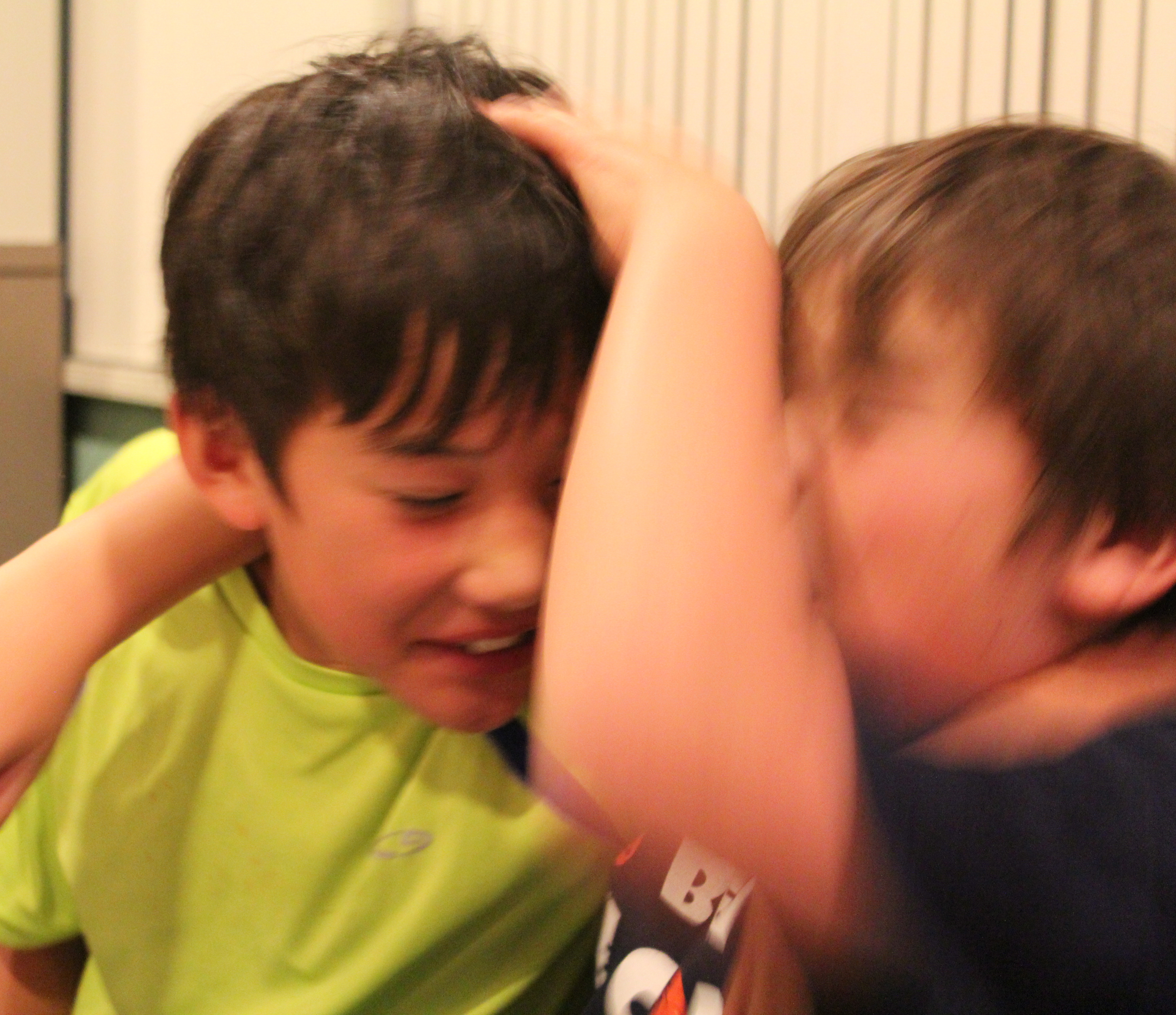
I love the moments when my boys are like this:

But let’s get real. There are plenty of days when they’re like this:

This afternoon they left in high spirits to play tennis at the courts in our neighborhood. I’m still not sure what happened at the tennis courts, but they returned home separately, both filled with fury and absolutely certain that the other had been grievouslyoutrageouslyunforgivably in the wrong. Venomous words and death stares were exchanged. Bitter tears were shed. They retreated to opposite ends of the house to marinate in their own bile.

I wondered if I should dispense a few bromides, make them hug it out, or exact insincere apologies from both aggrieved parties. Being the exceedingly lazy person that I am, I decided to do the easiest thing: nothing at all.

I was reminded of how my mother dealt with us when we quarreled as children…

One day my older sisters were bickering with each other. My mother frogmarched them into the kitchen, poured herself a cup of coffee, drew up a chair, and in a brisk, business-like tone instructed them to punch each other.

My sisters looked at her and then each other with intense embarrassment and discomfiture.

“Well?! You wanted to fight. So fight. Go on!” she said, drumming her fingers on the kitchen table.

They stood there looking miserable.

“Amie, you punch Annabelle,” she urged. Weeping now, my sister declined.

“You wanted to fight, so fight, I said! Go on! Punch Annabelle as hard as you can!”

Seeing that my mother would not be deterred, Amie weakly nudged Annabelle with a closed fist. Now my mother was really enjoying herself. She took another long swig of her coffee and said, “OK, Annabelle. Now you punch her back. Go on!”

When Annabelle, who was also sobbing by now, returned the nudge, they were both finally released from the horror show.

Years later my brother and I were squabbling about something or other when my mother remembered the diabolically clever penal scheme that had sprung like a miracle from her brain: the perfectly formed child of her fertile imagination. She couldn’t wait to relive the glory of the moment.

“You want to fight?! OK! Go on, fight! Adrienne, you punch Teddy.”

I can only imagine the satisfaction she felt as she watched the scene of her past triumph repeat itself.

“But I — don’t want — to hit him!” I blubbered and spluttered and managed to gasp out.

“I said, HIT him! You want to fight so badly, here’s your chance. I’m not stopping you! PUNCH him as HARD as you can!”

It was clear to me that we were mere puppets in this twisted demonstration of my mother’s disciplinary ingenuity and that the show would only end when we did as we were told. I delivered the first symbolic “punch,” a mere brush with my knuckles.

My mother pounced, practically spitting in glee, “Teddy! It’s your turn. Now you punch Adrienne!”

She didn’t need to tell him twice. He turned and punched me so hard I landed on my beleaguered ass clear across the room. That was the last time she ever tried that. But hey, it all worked out in the end…My brother and I love each other, and I even named my own son after him. The slurred speech and blurred vision eventually cleared up. And as for the memory loss? Who wants to harbor bitter, unpleasant memories anyway?

This afternoon I heard a lot of sniffling and muttering that went on for hours. Nicholas eventually started to do his homework in the dining room. Teddy took up his ukulele in the living room next door and started strumming it softly.

“Who’s playing the ukulele?” I heard from the dining room. I braced myself for the brouhaha that was sure to ensue and tried to head it off.

“Teddy,” I said, “Nicholas is trying to study. Why don’t you go up to your room and play?”

“No, I like it.” Nicholas said from the other room. “Teddy, you sound really good.”

And that was that. Peace in the valley once again.

Take me back to San Francisco

First published last September…

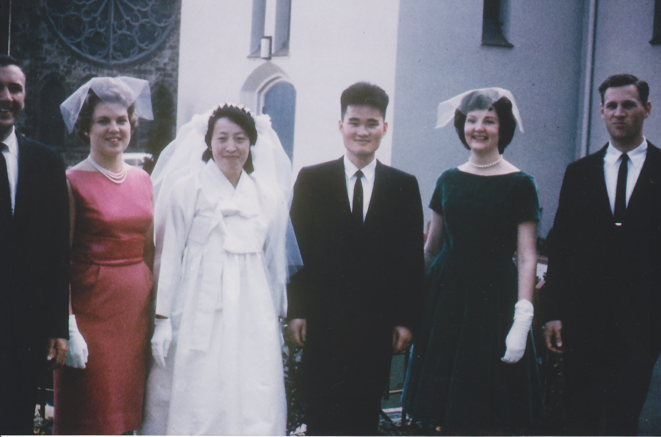
I’m on a plane heading to San Francisco for my cousin’s wedding. Actually, while I will be going to the wedding, I’m really going for my parents, who are using this happy pretext to revisit the place where they began their own life together as a married couple.

In February 1963, my father was a student in San Francisco. Against all odds, he had managed to make his way to the U.S. to pursue the education that had cruelly eluded him during a childhood filled with adversity and suffering.

School was a luxury, a beautiful dream that was constantly interrupted, snatched away, and cut short by real nightmares:  air raids, forced labor by the Japanese occupiers, disease…The sudden and premature death of his father was disastrous for his family, already reeling under the privations brought about by the occupation. My father witnessed beloved siblings die from malnutrition – the very thought brings me to my knees. The family was able to scrape together enough money to pay for only one son’s school fees. The others had to help on the farm so that the family could survive.

When my father’s older brother saw how desperate he was to get an education, and though he would sorely miss his help on the farm, he gave him his blessing to leave home at the age of 13 in pursuit of his dream. My father would have to find a way to support himself through school. He still remembers his brother’s sacrifice with deep gratitude.

He walked for days to get to Seoul, where he found a job sweeping glass in a watch factory. He worked during the day, went to night school, and at the end of every long day, he would sweep clean a place on the factory floor where he would sleep. Eventually, he enrolled in a new college that had the lowest tuition he could find.

The school’s president was the scion of a family of Catholic martyrs: three generations of his family were wiped out on one day. His own father had physically survived the massacre, but was a ruined, broken man. The president had gone on to become the leader of a Christian underground resistance movement. He was repeatedly arrested and tortured by the Japanese for his activities and was always on the run. Fearing for her own safety, his wife would dress as a beggar and hide in the busy marketplace all day, returning home to their children only late at night. Eventually, he led a large group of hundreds of refugees to Manchuria, an arduous journey on foot during which his youngest child, an infant, died. When he was finally able to return to Korea, he founded the college.

My father became the president’s star student. He had a fierce hunger and passion for knowledge. He gorged himself on philosophy, history, languages. Emboldened by a degree finally under his belt, and encouraged by American G.I.s he met while doing his compulsory military service, he took and passed a test, which would allow him to continue his studies in the U.S.

Before he was about to graduate, my father went to the president’s office to tell him that he was getting married. The president congratulated him heartily, and it was only then that my dad revealed that he was going to marry his own daughter, my mother. The college was (and is) an institution where skirt hemlines are strictly monitored and relationships between the sexes are discouraged. How my dad worked up the nerve to court and get engaged to the president’s daughter behind his back is unfathomable to me. His placid, gentle demeanor belies steely, ballsy determination that has carried him throughout his life.

So in February 1963, my mother stepped off the plane in San Francisco to meet her soon-to-be husband. Their separation had been long. Her arrival had been delayed by a year when an x-ray revealed that she had had tuberculosis as a child. She spent the year listening to tapes, trying to learn English. She still sometimes mimics the stilted, heavily accented recordings that she would listen to over and over again: “I am a boy.” “I am a girl.”

It was a difficult first year for my mother. She cried every day because she was homesick and so far away from home. The birth of my oldest sister, and my second sister soon after, brought comfort and joy. As their family grew and they settled into their new country, my parents began to build a happy life together. Painful memories of the past receded as they made new memories: outings to the zoo with their daughters, the taste of sourdough bread, eating watermelon in their little apartment under the belfry of the Hamilton Square Baptist Church.

Standing in front of Hamilton Square Baptist Church

Photos and more about our visit to my parents’ first home here

Enhanced by Zemanta

I am truly evil.

In terms of my relationship with my adolescent, this past year can be summed up with a series of pictures and graphs:

rough roadThe rough road we’ve traveled this year with our son has lined my face with new wrinkles and has added gray hairs to my head.

At first there were road blocks that had to be negotiated. Eventually, the way was blocked off entirely.road closed

For a long time, there was no easy way to get through to the other side.

no bridgeBut just when I had lost all hope, the foundation of a new and stronger bridge was put in place.

rebuilding bridge

And then, one fine day:

new bridgeWhere once my son’s moods could be described by this sine wave:

fig. 1fig. 1

They are now more like this:

fig. 2fig. 2

Nowadays, when I open my mouth to say something, I can reasonably expect NOT to have my words immediately torched to cinders as if by a giant flamethrower.

Lately, I can generally get through the day without being reduced to a quivering mess of raw, exposed nerves because of some act of poor judgment or lack of impulse control on my son’s part.

It is so sweet.

It’s time to celebrate this time of intellectual and emotional growth that has come hand-in-hand with my son’s physical growth. It’s time to rejoice in the relative peace and harmony that has descended upon our household.

It’s time…for payback!

I am now going to reveal a delightful secret to those of you who may have children on the cusp of adolescence…Right now, your young adult is at the most sensitive, vulnerable time of his or her life. They are yearning for approval and acceptance by their peers. It doesn’t take much at all to embarrass them. Think of this embarrassment as the very wellspring of your own illimitable powers. Yes! Be glad! Breathe deep the heady aroma of your own might, (while at the same time willing yourself to ignore the stench of the sweaty socks strewn about your minivan and home). These days, even as my son grows taller than me by the minute, my power over him grows at an even more astonishing rate. I have in my clutches the ultimate weapon – the power to embarrass, and the shamelessness to deploy this cruel, cruel weapon.

This past weekend one of Nicholas’ friends came over for a sleepover in the middle of the night when his parents had to make an unexpected trip to the ER. I got out of bed to help Nicholas blow up the air mattress while Colin went to pick up the friend to bring him back to our house. Nicholas kept insisting that he could handle it himself, and kept urging me to go back to my room. He was getting more and more agitated about my presence and I simply couldn’t comprehend why until at last he said, “He’s going to be here soon. Don’t you think you should put some pants on, or something?

I looked down at the ratty, oversized tee-shirt I was wearing as pajamas, and because I am an evil, evil human being, who suffered the tongues of flame in the deepest bowels of adolescent hell this year, I replied nonchalantly, “Nah. He’s just like family. He won’t mind at all.

Oh, how I relished every second of my son’s squirming until I finally took pity on him and went to change. When I considered all the many battles we fought over his wardrobe over the course of this past year, I couldn’t help but think that I’d let him off too easily.

Later in the weekend he told me that he was going to DJ for the upcoming school dance. The perfect opportunity, once again presented to me on a gleaming silver platter! How could I possibly resist?

So, I’m sure they’ll want parents to chaperone, right? Because I’d love to be there for your gig.

An eerie silence immediately filled the car. The words “shock and awe” sprang unbidden to my mind.

Mom. I love you so much, but...”

I cut him off with my wild, demonic cackling.

My God! Life really IS good!

My Brother is Special, Pt. 2

A couple weeks ago, I wrote about how my genius brother managed to game his way into the local preschool for children with learning delays. Yesterday I wrote about the few shows we were allowed to watch on television before my mother decided to destroy the set in as dramatic a fashion as possible. These posts got me thinking about another incident that involved my brother, school, and our family’s warped relationship with popular culture via the television…

Bow-tieMy brother Teddy discovered Fat Albert and the Cosby Kids in Kindergarten. He became completely enamored with the show, and with the character named Mushmouth in particular. Mushmouth is the slack-jawed character, who speaks with the slow, rhythmic cadence of a simpleton. He adds “buh” to every word so that he sounds something like this: “Heybuh, Fabuh Albuh.”

Teddy began talking like Mushmouth. Constantly. Concerned, his conscientious Kindergarten teacher alerted the specialist at the school, who began to pull him out of his regular classroom for intensive speech therapy.

When my dad got wind of this, we knew it was going to be ugly. As punishments were always meted out communally in our household, my sisters and I were all made to sit alongside our brother on the couch as my dad ranted on and on and on. It seemed like the hailstorm of words pelting down from that normally monosyllabic, phlegmatic man would never stop. In a thousand and one different ways, for what seemed like a thousand and one hours, he told Teddy that if he continued to talk like Mushmouth, people would think he was a Dummy, a Straggler, and a Weakling!

At long last, his lecture came to a terrifying crescendo with a thundering: “DO YOU UNDERSTAND ME?!

Teddy answered:  “Yehbuh.”

Our jaws dropped involuntarily and my sisters and I froze in a tableau of mute horror. We held our breaths as we waited for the axe to fall. But so habitual had become this idiosyncratic way of speaking, my Dad didn’t even notice.

Enhanced by Zemanta

Fenwick Island

I went to Fenwick Island on a mission. A few years ago we went to the Outer Banks with my dear friend Rosita and her family. One day Rosita took this picture of us:

Cliché thought it may be, I loved the white/khaki look. I loved that late afternoon light. I was determined to recreate the photo at Fenwick Island. I made sure to pack white and khaki outfits for everyone. The day before we were going to leave at the end of our vacation, I announced that it was time for our photo session. I made everyone get into their designated photo togs, some of them newly-bought just for the occasion. We wasted precious daylight as Teddy searched unsuccessfully for his khaki shorts.  (The following week my sister emailed me to say that they had mistakenly gotten mixed in with her boys’ shorts). I admit it: I was insufferable. I stormed around looking for the shorts and making my son look for the shorts and even seriously considered making him wear a pair of women’s khaki shorts until my sister ripped them out of my hands and said, “NO.”  I finally, huffily conceded that navy shorts would have to do. We went out onto the beach and my daughter immediately got a piece of sand in her eye. Through tears she insisted that she couldn’t open her eyes.  And because I am a horrible, horrible human being, I heard myself saying absolutely outrageous things like, “Try not to cry for just one second! Just open your eyes and pretend not to cry on the count of three!” Truly, I had become unhinged…and I totally got what I deserved:

I did manage to get some better ones throughout the week. Here are some of my favorites:

Enhanced by Zemanta

The “Golden” Finale!

Here’s the last half of the slideshow my sister and I put together for my parents’ Golden Anniversary party:

Each of carries within us a piece from past generations: an aptitude, a special talent, a twinkle in the eye, a smile.

Fortitude. Courage. Conviction. Cheekbones!

Intelligence. Creativity, Vision.

And as the next generation grows up, we are thankful for the many gifts and lessons passed down from our parents.

I discovered this in my second grader’s desk at Back to School Night this past year. I was so very proud.

Ummm…we’re still working on that one.

I’m quite convinced that my mother could whip up a teleportation device, if given a handful of paper clips, some tinfoil, and maybe a few coat hangers…

Snappy dressing? Let’s just say it’s a family tradition

“What’s that, Mom? You want me to pick up the money, do you? Hah! Here’s what I think of your money. I’m picking the pen, so you better start saving up…I’m planning on grad school!”

We sometimes disagree. Correction. We frequently disagree. Correction. We always disagree.

But we sometimes, frequently, and always kiss and make up.

And yes:

It must be genetic.

Thank you, Mom and Dad, for giving us 50 memorable years filled with love and joy. We love you.

Wishing each and every one of you a beautiful weekend. 

Enhanced by Zemanta