The First Day of School

The First Day of School

My mother is tired of this world
She is silent and impatient
With the inexorable gravity
That encumbers each step and
Forces surrender to the waiting bed

I’m a middle-aged woman now
Struggling to look jaunty as I run
So as not to shame my children
Riding past me on the school bus

Just a moment ago at the bus stop
My son crouched to whisper
In his sister’s ear, “In Kindergarten
You have to pay attention to your teacher
And listen to every word she says.”

These words are weightless and indissoluble –
As indelibly engraved upon his heart as on mine
These are my mother’s words, flitting now
Like butterflies on the school bus
Lumbering up the hill.

8/25/2010

When I was a child, every morning before I left for school my mother would say, “Pay attention to your teacher. Listen to every word she says.” On my daughter’s first day of Kindergarten, as we were waiting for the bus to come, I was shocked to hear the very same words of advice coming out of her older brother’s mouth. I hadn’t even realized that I’d been echoing my mother’s words to my own children. After seeing all three of my children onto the school bus for the very first time, I started off for a run. I ruminated about the passage of time and the way in which words can be both weighty and weightless. They never age, and they can outlast us all.

Enhanced by Zemanta

Revolutionary Poetry

I’ve been reading Wallace Stegner’s Crossing to Safety, which traces the course of a friendship between two couples across decades. The husbands are both English professors and aspiring writers. One of them is a poet. In one scene the poet visits his then-girlfriend’s house and is drawn into a debate in which he is obliged to defend his wish to retreat like Yeats into a “bee-loud glade” to write poetry. “Poetry isn’t direct enough most of the time,” his soon-to-be wife protests, “It doesn’t concern itself with the vital issues. It may be nice to know how a poet feels when he looks out his window into a fresh snowfall, but it doesn’t help anyone feed his family.”

The same day I read this passage, I happened to read an interview with one of my favorite poets Li-Young Lee. He reveals that there was a period in his life when he wanted to quit writing poetry because he felt that writing poetry was inconsistent with the life of activism that he was trying to lead. He tried to set poetry aside, because it “didn’t do anything.”  (“The Totality of Causes: Li-Young Lee and Tina Chang in Conversation“).

Of course, this is a debate that has been going on for centuries. Does art have intrinsic value, or does it need to “do something”? Can we subject art to a value scale based on its utility? Where would utilitarian art or purely aesthetic art fall on such a scale?

I was delighted to discover the “Revolutionary Poetry” wall in Revolutionary Soup, a restaurant on the Corner in Charlottesville. Every time the door opens, the scraps of paper and napkins on which poems have been written flutter in the breeze. Some of the poems are quoted, some have obviously been written on the spot. “Leave one, or take one as you see fit,” says a card tacked up in the upper left hand corner. The poetry board encapsulates many of the reasons why poetry really does matter, and how it “does something.” Poetry inspires people to contemplate and interpret life through an aesthetic prism that demands a certain amount of concision. A poem’s brevity allows it to become a commodity or a gift that can be easily and freely exchanged. A poem may never feed a family, but, to quote the napkin poet, “the destination is filling.”

Here’s my poem scrap written long ago for my friend Amanda, who first introduced me to Li-Young Lee and many other poets…

For Amanda

My friend stores away poems as if they were glittering treasures.
On special occasions, she brings them out to show you.
She tells you their story, one by one
How they were bought, discovered, given.
But instead of putting the bracelet back in its velvet pouch,
Hanging the necklace back on its golden hook,
Or nestling the ring back in its jewelry box,
She hands it to you, and lets you wear it home.

Enhanced by Zemanta

The Fragrance of Ink

Many years ago I saw a traveling exhibit of literati paintings of the Choson Dynasty from the Korea University Museum. I was enchanted by the name of the exhibit – “The Fragrance of Ink.” Inspired by that evocative phrase, I wrote this haiku. (Is it cheating that I didn’t make up 1/3 of the poem)?

The fragrance of ink
Is subtle, but insistent
Lingers, and is gone.

This literati painting is my favorite work of art that I own. It was done for my father by his friend, a well-known calligrapher. The words are a description of my father’s character:  “Deep thoughts, Great spirit”:

Detail:

I love how the vigorous characters boldly wriggle, leap, pirouette and undulate as if they were going to dance right off the paper.

May your weekend be filled with beauty.

“For love is strong as death”

Screen Shot 2013-01-09 at 7.05.50 PMI met my friend’s mother for the first time when I stayed at her house many, many years ago. I think we may have both still been in college at the time. I remember her mother as a quiet, petite woman with blonde hair swept back into an elegant, old-fashioned bun. She had a gentle, golden presence.

My friend’s mother, like mine, was an émigré and spoke in softly accented English. She, like my own mother, was a gifted gardener. Her garden, like my mother’s, was an exquisite masterpiece wrought of love and an instinctual eye for beauty. If my memory serves me correctly, her mother, like my own, loved peonies best of all. When my friend and I recently reconnected, we made the sad discovery that both of our mothers were suffering from the same, fairly rare disease.

Last week she wrote to tell me that her mother had just lost her battle with the disease. I never have the right words for moments like these, so I am borrowing Edna St. Vincent Millay’s instead:

Dirge Without Music

This is for you and your mom, my dear friend. In my mind, she is in a beautiful garden. She is in a skirt and a blouse with a cardigan draped over her shoulders. She is bending to smell the lovely fragrance of a peony.

Sending you oceans of love.

“Set me as a seal upon thine heart, as a seal upon thine arm: for love is strong as death.” -Song of Solomon

Enhanced by Zemanta

Happy New Year!

The Darkling Thrush
by Thomas Hardy

I leant upon a coppice gate
When Frost was spectre-gray,
And Winter’s dregs made desolate
The weakening eye of day.
The tangled bine-stems scored the sky
Like strings of broken lyres,
And all mankind that haunted nigh
Had sought their household fires.

The land’s sharp features seemed to be
The Century’s corpse outleant,
His crypt the cloudy canopy,
The wind his death-lament.
The ancient pulse of germ and birth
Was shrunken hard and dry,
And every spirit upon earth
Seemed fervourless as I.

At once a voice arose among
The bleak twigs overhead
In a full-hearted evensong
Of joy illimited;
An aged thrush, frail, gaunt, and small,
In blast-beruffled plume,
Had chosen thus to fling his soul
Upon the growing gloom.

So little cause for carolings
Of such ecstatic sound
Was written on terrestrial things
Afar or nigh around,
That I could think there trembled through
His happy good-night air
Some blessed Hope, whereof he knew
And I was unaware.

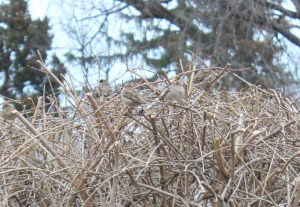
IMG_1103Many say this is a poem about Hardy’s pessimism and turn from faith and it’s easy to see how it could be read this way.  But it’s also possible to see this as a poem of hope. Against a bleak landscape, an “aged thrush, frail, gaunt, and small,/In blast-beruffled plume,/Had chosen thus to fling his soul/Upon the growing gloom.” Even if there is “little cause for carolings,” the little bird’s “full-hearted evensong of joy illimited” rings out through the night with “Some blessed Hope, whereof he knew/And I was unaware.”

My resolution for this New Year is to be a little more like this “blast-beruffled bird” and to “fling [my] soul upon the growing gloom” with a song of Hope even when it seems like there is little cause.

May each and every one of us experience moments of “joy illimited” this year.

Enhanced by Zemanta

Jubilate Agno

I was first introduced to Jubilate Agno in college, when my choir sang Benjamin Britten’s cantata “Rejoice in the Lamb,” based on the poem. I’ve been revisiting the very long and weird poem that English poet Christopher Smart (1722-1771) wrote between 1759 and 1763, while he was in an insane asylum. The poet was afflicted with a religious mania that would compel him to fall to his knees and pray in public places. In Jubilate, Smart refers to the incident which may have resulted in his being sent to the asylum:

For I blessed God in St. James’s Park till I routed all the company.
For the officers of the peace are at variance with me, and the watchman smites me with his staff.

There is some speculation that Smart’s father-in-law committed him to the asylum, not because he was insane, but because they had been bitterly arguing over huge debts Smart had accrued with his extravagant alcohol-soaked carousing and spendthrift ways. If you read Smart’s poetry, though, it’s hard not to conclude that he was, in fact, mad. You can find the full text of Smart’s poem here.

Jubilate Agno wasn’t published until 1939, and only became more widely known with Britten’s musical adaptation in 1943. American poet Edward Hirsch has written a more recent response to Jubilate Agno with a poem of his own, called Wild Gratitude, which you can read on the poets. org website. What I like about Hirsch’s poem and Smart’s is the appreciation for the wide spectrum of experiences that make up our days. Smart writes about the cosmic:

For THUNDER is the voice of God direct in verse and music.
For LIGHTNING is a glance of the glory of God.

But he also writes about everything from the humble Beetle “whose life is precious in the sight of God, tho his appearance is against him” to “NEW BREAD,” which “is the most wholesome-God be gracious to Baker.” Everything is worthy of praise and blessing from the “Postmaster general and all conveyancers of letters under his care especially Allen and Shelvock” to the “ostriches of Salisbury Plain, the beavers of the Medway and silver fish of the Thames.”

The best known lines of the poem are the ones Smart wrote about his cat Jeoffry, his only companion in what amounted to solitary confinement at the asylum. I’ll quote Britten’s text for “Rejoice in the Lamb,” which abbreviates and slightly reorders Smart’s much longer text:

For I will consider my Cat Jeoffry,
For he is the servant of the Living God duly and daily serving him.
For at the first glance of the glory of God in the East he worships in his way.
For this is done by wreathing his body seven times round with elegant quickness.
For he knows that God is his saviour.
For God has blessed him in the variety of his movements.
For there is nothing sweeter than his peace when at rest.
For I am possessed of a cat, surpassing in beauty, from whom I take occasion to bless Almighty God.

I was thinking about this poem as I drove to work today and thought about the gamut of experiences that add up to a day. Sometimes it’s witnessing a spectacular sunset while waiting for your kid’s soccer practice to end:

Sometimes the experiences are less obviously remarkable, though perhaps no less worthy of notice and praise. I decided to catalogue and record some of these things just for this one, (extra)/ordinary Thursday.

1. I saw a mother and daughter (from China, I think) waiting on the sidewalk for the girl’s school bus. I realized this morning how much I look forward to seeing these two at the start of my day. Sometimes they face each other, unselfconsciously flapping their arms and doing some kind of calisthenics. Sometimes they are back to back, their arms linked, and the mother is lifting her daughter off the ground and onto her back. The little girl is always laughing with unbridled joy and a huge grin on her face. I wish I could take a picture of them, but I’m sure that would totally creep them out and I might end up in an asylum myself.

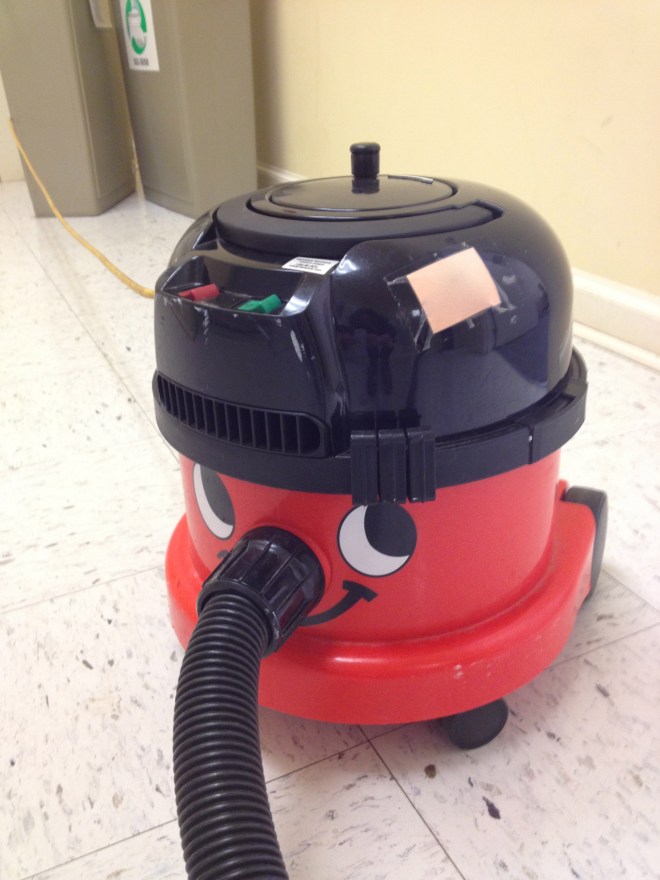
2. When I got to work, Henry the vacuum cleaner was hard at work cleaning the carpets:
IMG_1774

I know it’s ridiculous, but I have very warm, fuzzy feelings for this vacuum cleaner.

“For I rejoice in Henry that ministers to the carpets with a cheerful countenance.”

3. Then I saw the front page story of the student paper:

It made me giggle to think that the worst injustice the students are protesting so very earnestly, (at least for today), is the banning of Christmas decorations for safety reasons.

4. I drove back home after work past fields with cows and hay bales and a collage of blue mountains in the background and felt richly blessed.

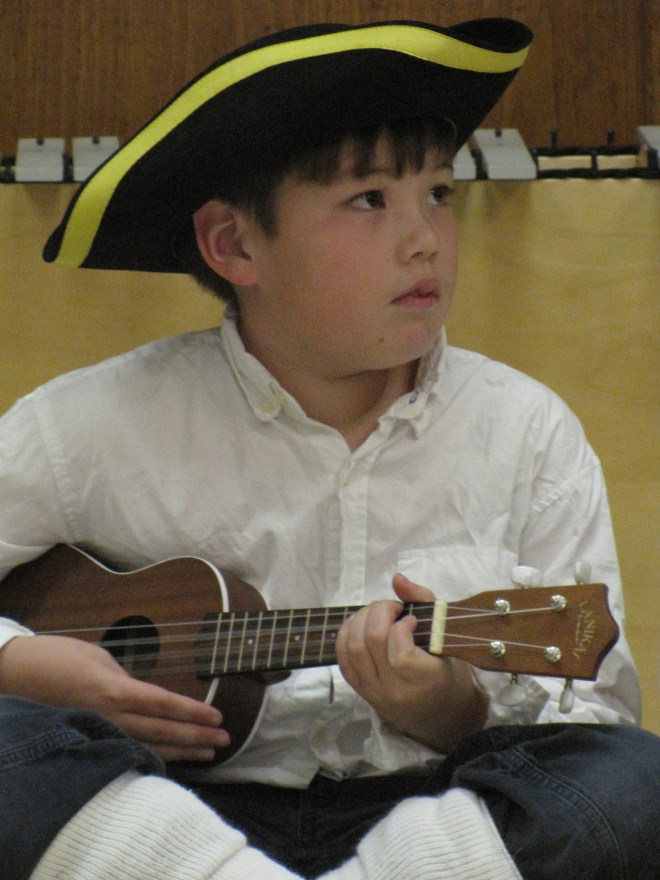
5. After a quick dinner we all piled into the car to head to my 5th grade son’s “Colonial Day” concert at school:

He kept cracking up as he looked out at us. Check out his colonial footwear. I’m pretty sure the real colonists weren’t strumming “Johnny Has Gone for a Soldier” on ukuleles, but that’s o.k.!

6. And now, as I type late into the night, I am contemplating my two cute but rotten dogs:

IMG_1451“There is nothing sweeter than [their] peace when at rest,” (i.e. not peeing on my couch, eating poop, throwing up, trying to steal chocolate, drinking water from the Christmas tree stand…). Colin says I should have just gotten myself a couple of stuffed animals. I hate to admit it, but I think he may be right.

7. And lastly, look what arrived for me today all the way from Hawaii:

IMG_0494

Jubilate Ukulele!
Hope your weekend is wonderful in small and big ways.
Enhanced by Zemanta

On Being Human

IMG_1773I’m having a hard time understanding why I wasn’t invited to participate in this lecture series. If ANYONE knows ANYTHING about being human it would have to be me. If there’s one thing in the world that I can claim expertise in, it would be this. In fact, I may be THE world expert on being human. Whatever. Here’s a poem I wrote on the subject a few years ago:

Human Metallurgy

We are forged in a blazing refinery
Spewing black ash and sparks.
The backwash of ancient alchemy
Erupting forth in flaming arcs.

We are works in progress
Liberated from rubble,
Fire granting us egress
In a glowing crucible.

Tongues of flame unravel our bonds
We are relieved of our dross and left purified
Naked, we lie in shimmering ponds
To await the next process by which we are tried.

We are alloyed, coerced into transformation:
We are strengthened, or made more malleable.
Our baser selves bettered by the amalgamation:
By virtue of borrowed traits more valuable.

We are extruded, rolled, tempered, annealed,
Poured into die casts, pressed into molds.
Struck by hammer blows, our song unsealed,
Then flattened into sheets, or crimped into folds.

We are worked over by many hands
Wrought with inspired artistry
Or artifacts of belabored plans
Endproducts of earnest industry.

And after the art or the manufacturing,
Are we in unpathed waters, on an undreamed shore?
Jewelry, carburetor, or some leftover thing
To be melted again and reused once more?

Fall Roundup, Part 2

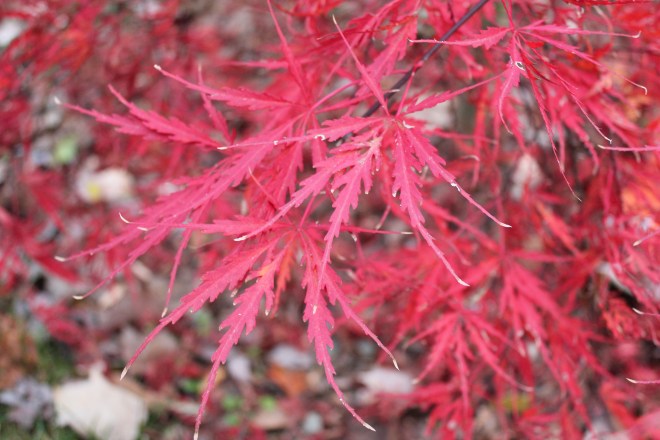
I’m holding on tight to these last days of Autumn. I’ll miss the crisp weather tempered by the warm sun. I’ll miss the spectacular kaleidoscope of colors…

Here’s a link to a lovely autumnal poem:  Fall, by Edward Hirsch at the poets.org website.

You can subscribe (for free) to The Academy of American Poets’ “Poem a Day” on the poets.org website to have a poem like this one sent to your email address every day.

Enhanced by Zemanta

The dream

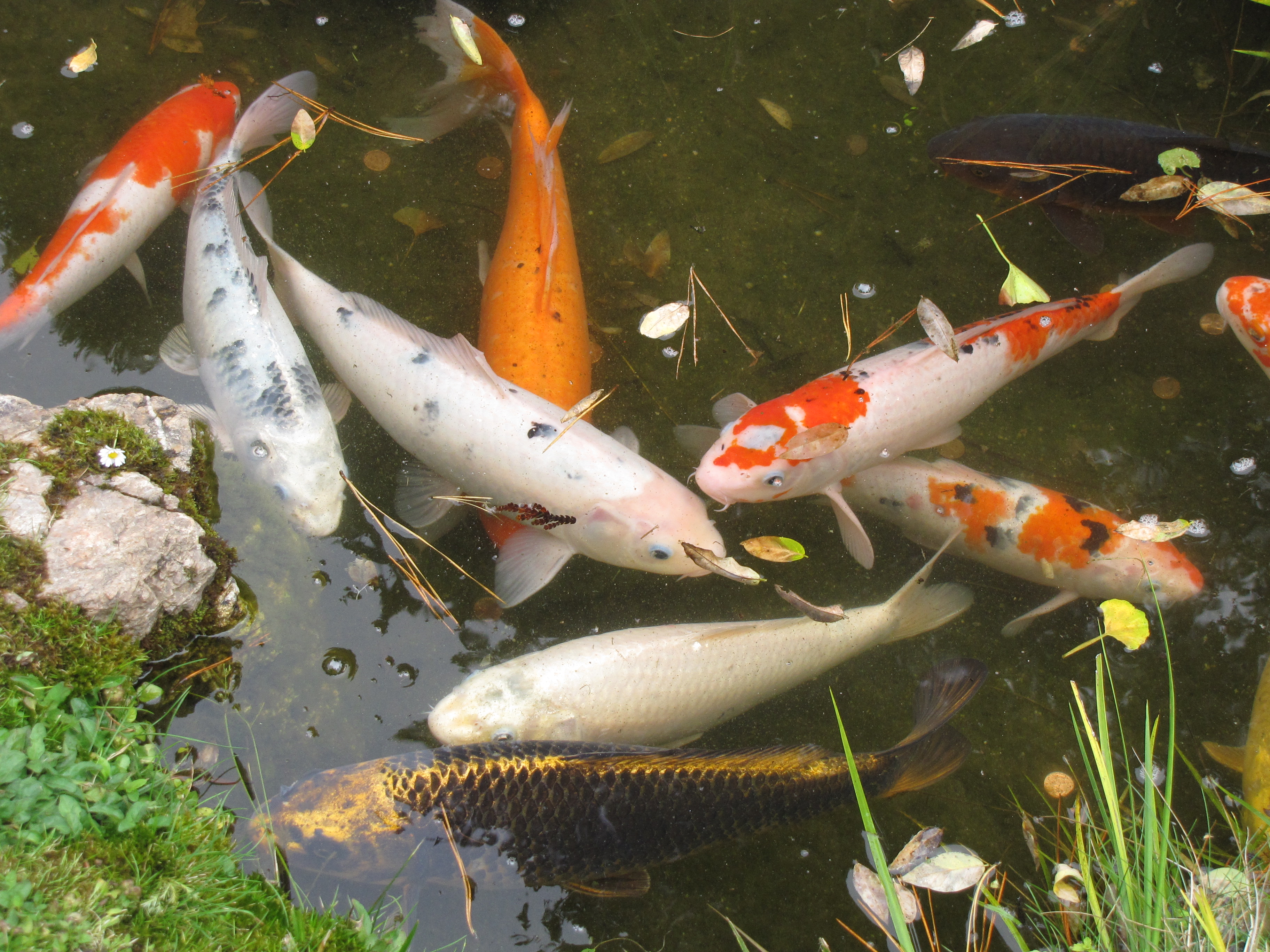
My son has loved and lost many fish over the years…A couple years ago he had a dream so beautiful and sad that he reported it to me the next morning through tears. In his dream he witnessed all the beloved fish he ever had swimming up to heaven. I wish I were an artist so I could paint the picture he described to me so vividly. I wrote this poem for him instead.

It happened only once, and never again
A vision so beauty laden
As to bring a young boy to his knees
A silvered ripple of gold, orange, red, and ebony:
Comets, black moors, celestials, veiltails,
Shubunkins, telescope eyes, ryukins, and pearl scales,
Swimming upstream through the cold night air
Their spellbinding, unrehearsed synchronicity
Shimmering and incandescent as they made their way
To some promised piscatorial paradise
Where the neglected and the overly loved
Find blessed peace and rest.

For my son
1/10.

Call Me Jezebel

About four years ago, we spent a year in Carrboro, NC – surely one of the coolest little towns on the face of the planet. My husband spent his sabbatical as a Fellow at the National Humanities Center, where he spent long hours pondering over eternally vexing and abstruse philosophical questions. And me? I got to hang out for a year.

I met Amanda, a fellow collector of “crazy but true” stories (she’s got an endless supply of the most entertaining ones). She’s also a collector of poetry, and she introduced me to some  poems that are now among my favorites. She herself is a gifted poet, who can put words together on a page that will make your toes curl. Her writing can make you gasp and then forget to exhale. We would meet at the Open Eye Cafe every Tuesday from 9 pm till closing, where we’d drink weak, lukewarm tea, read what the other had worked on that week, and dream up all kinds of kooky plots and schemes. During that year Amanda hatched a non-profit to help the prostitutes of Durham, a business plan to market ironic tampons and maxi pads, and  we started writing blues songs together. It was that kind of year…all about Possibilities with a capital P.

Here’s a twisted little poem I wrote for one of our Open Eye sessions in the prevailing spirit of “what if?” It’s written from the point of view of the woman who’s married to Batman. She’s had a youthful dalliance with the Man in the Yellow Hat, and is now having an affair with Robin. It seemed somehow appropriate for the week of Halloween…

Call Me Jezebel

Hurl your stones and call me Jezebel.
You have no idea what a living hell
It is to be married to the Prince of Darkness.

Would it kill him to leave one lousy light on, I think
As I grope my way to the kitchen for a drink,
Praying I don’t wake that damn butler, (“His Highness”)

I could swear today I saw the old toady look at me and sneer,
As he purred – sotto voce – in his beloved master’s ear.
Then off He swooped – all dark glamour and leather menace,

Gunning the engine of that sleek monstrosity –
A monument to selfishness and impracticality,
Bordering on sheer malice.

How are we supposed to fit a car seat in that thing?
I asked him once, but that was in the beginning…
Before I gave up buying lamps and looking for windows to open.

So maybe I was a fool for trading in the sun for the moon:
The boy next door, who came to call on me one afternoon
Yellow hat in hand, tall and slim and soft-spoken.

Dazzling in his golden wholesomeness, he asked me to wait for him.
But when he ambled back, with a pet monkey peeking from under his hat brim,
My chiropteran Lucifer had long since swept me up under his black wing.

They tell me he still lives alone in that fairy tale house of his,
But can you blame me?  Who wouldn’t be suspicious
Of a grown man who shares his bed with a monkey?  In traitorous spring,

I’ll admit, I called him, one bitter, lonely night
But when he answered, half-choking with delight-
I hung up:  on him, on a life half-lived, half-loved, then lightly betrayed.

He was the bright peddler of my fondest, callow dream,
Too soon outgrown and cast downstream.
But sometimes I used to wonder, should I have stayed?

Until the night I saw a boy with a bird’s soul and name.
(A harbinger of my Spring?) He was awash in moonlight and aflame
With reverence for the Devil himself:  my husband.

Dynamic duo?  Hardly!  He suffers the boy to trail starry-eyed in his wake,
Chirping sophomoric punchlines that would make your teeth ache
Like a mere sidekick:  Sancho Panza or Doctor Watson.

But it’s this bejeweled bird who casts the unjaded, vital glow
That fleshes out and deepens his black shadow
And in so doing, animates the demon’s chiaroscuro!

It’s true I chose him for a ripe and gratifying vengeance
But in his guileless, openhearted innocence
I found light and sweet consolation…Oh, I know

It torments him.  He weeps and talks of betrayal
I cover his mouth with my own – to no avail.
The words I whisper fall glib and hollow.

I tell him we are necessary to one another,
Each to each:  an unholy trinity. (Father, Brother, Sister? Mother?)
This tripartite union is our shared lot. It is our fortune.

Not for me the storybook house with shutters and flower filled window boxes.
I’ll live out my life here, in a mansion built over a cave, breathing air foul and noxious,
Befitting an unworthy chorus member in a gothic cartoon.

I’ve relinquished the sun,
Sold my soul to the moon.
But I’ll never give up my starlight.

Enhanced by Zemanta