How my brother foretold his future when he was 1 year old

This is my little brother Teddy on his first birthday (dol). In Korea, the first birthday is celebrated as one of life’s most important milestones.
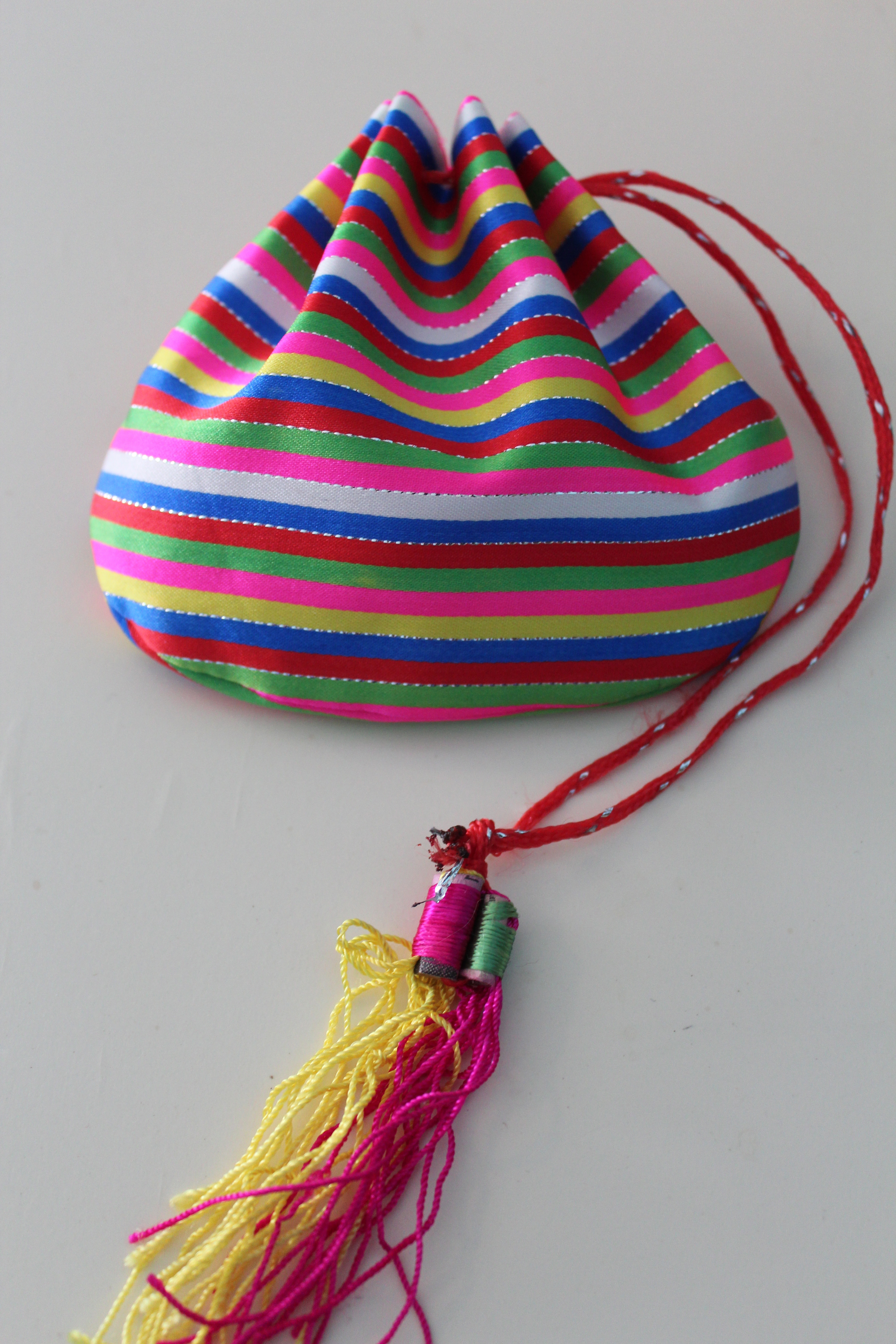
Cardinal ColorsTeddy is wearing the dol-bok, worn for the first birthday celebration. The stripes on his sleeves are in the traditional Korean pattern that incorporates the five “cardinal colors” of Yin and Yang. White represents metal, red represents fire, blue represents wood, black represents water, and yellow represents the earth. This colorful striped pattern is worn only by children and is meant to protect them from evil spirits. The long belt wrapped  around his body represents  longevity. A pouch like the one to the right, is strung on the belt for good luck.

Traditionally, the gods Sanshin and Samshin Halmoni were honored at a first birthday celebration with offerings of food and prayer. Sanshin, the Shaman mountain spirit, (who has also been assimilated into Buddhism), grants prayers for sons. He is always depicted as an old man with a tiger by his side. Samshin Halmoni, or Birth Grandmother, is the Shaman spirit of childbirth.

Symbolism imbues every aspect of the first birthday celebration. With a decorated screen as a backdrop, a round prayer table is set with an abundance of auspicious foods and objects. The roundness of the table ensures a smooth life without conflict and hardship.

To cut a flower would be to cut short the life of a living thing, so only a potted orchid and artificial flowers (both seen on the left) decorate the table. Bronze tableware is used to represent a bright future. Noodles represent long life. The bowl of steamed white rice symbolizes wealth. The association is made explicit by the coins that are actually placed on the rice. Behind the bowl of rice are jujubes, which represent abundance, fertility, and prosperity. Other fruits are piled high in the display. The parsley to the right represents good health, longevity, fertility, and also marriage. Next to the parsley is a skein of thread for longevity, and coins for wealth. Usually one would find a bowl of seaweed soup, closely associated with birth and birthdays. An assortment of rice cakes is also usually present on the table. White rice cakes represent purity, rice cakes coated in red bean powder are meant to ward away misfortune, the multi-hued rice cake seen on the back right is meant to ensure that all of these good wishes for the child will come true.

The birthday celebration culminates with the doljabi ceremony, during which the one year old foretells his future by selecting an object laid out on a table. For our first birthday parties, our family has always set out the three most commonly used objects. If the child chooses the pen, he’ll become a scholar. If he picks money, he’ll be wealthy. If he picks the thread, he’ll live a long life. Sometimes the doljabi can be even more elaborate:

The child who chooses the bow and arrow will become a warrior. The medallion represents fame and prestige. Note the stethoscope and judge’s gavel on this doljabi table!

In the photo of my brother Teddy’s doljabi, you can see him foretelling his future with amazing prescience. He picked up the pen and then jabbed it into his cake. After four straight years on the Dean’s list in college and after a brilliant three years of law school where he distinguished himself as the editor of the law review, Teddy found his true passion as a Crossfit gym owner. Nowadays he writes about nutrition and health on his gym’s blog…

and it was all foretold on his first birthday!

Enhanced by Zemanta

63 Bowls of Seaweed Soup, or: The First 21 Days

In Korea the 21st day of a baby’s life (Saei-rye), the 100th day of life (Baek-il), the 1st birthday (Dol, or Doljanchi) and the 60th birthday (Hwangap) are considered important milestones. Long ago, when infant mortality rates were higher and average life expectancy much lower than they are now, reaching these milestones was truly something to celebrate. Today, though life expectancy has greatly improved, these milestones are still marked with age-old traditions and celebrations.

A Korean mother and her baby are basically in solitary confinement (samchil-il) for the first 21 days of the baby’s life. They are not supposed to leave the house, and no one (except maybe the mother’s mother) is allowed to visit. Traditionally, a straw rope would be hung across the gate in front of the house to announce a baby’s birth and gender, to warn people away, and to ward off evil spirits. If the baby was a boy, anatomically suggestive red chili peppers or tassels in the shape of peppers would be entwined in the rope:

Does this remind you of anything?

Remind you of anything?

Pine twigs, representing longevity and virtue, would announce the birth of a baby girl. Bits of charcoal, representing purity, would be interspersed with the chili peppers and the pine twigs to chase away evil spirits.

When each of our nieces and nephews was born, my siblings and I were dying to go visit the baby right away, but were strictly forbidden to do so by my mother until the baby was 21 days old. When she found out that I had gone to a book fair with one of my own babies only days after giving birth, she was positively apoplectic. During the period of samchil-il, both the new mother and her baby are supposed to stay at home bundled in warm clothing to rest and recover from the ordeal of childbirth.

My son’s birth was indeed an ordeal. After 20 hours of labor, he was born with an alarmingly pointy head, jaundice, and a fever. I had a broken tailbone that left me unable to sit for 10 weeks and was a physical and emotional wreck. When we were discharged from the hospital, I was panic-stricken. Couldn’t the doctors and nurses see that I had no idea what I was doing? I was astonished at how irresponsible they were being to entrust this poor, helpless babe to someone as obviously unfit for motherhood as I was.

Those first weeks were a time of constant anxiety. I was given strict orders to nurse my baby every two hours to clear up his jaundice, but because of the jaundice, he was extremely sleepy and lethargic. I was instructed to do whatever I had to do in order to wake him up to nurse. A visiting nurse suggested that I wake him up by putting a cold wet washcloth on his face, but even that didn’t work. Trying to keep him awake, nurse him, and keep him wrapped in the biliblanket that was also supposed to help clear up the jaundice felt like a Sisyphean task.

Fortunately for me, my mother didn’t wait 21 days to come visit. When she arrived, the clouds finally parted. It was Easter. The sun was shining and the flowers were blooming. I look at photos of this day and I can see the relief and joy on my face:

My mother came with a bag full of exotic ingredients with which she cooked a gigantic cauldron of seaweed soup (miyuk gook) for me. This is the traditional postpartum food that a mother is supposed to eat for the first  21 days after giving birth. Why seaweed soup? The new mother is not supposed to eat or drink anything cold. She is also not supposed to eat anything that is hard to chew, as the gums have been weakened. More importantly, the iron, calcium, and iodine in seaweed are supposed to aid in the recovery after childbirth and milk production. Koreans traditionally eat this soup every year on their birthday, because it is so closely associated with birth. My mother urged me to eat this soup for breakfast, lunch, and dinner. I love Korean food, and my mother’s culinary skills are legendary, but there is no alchemy that can transform thick, rubbery bits of seaweed floating in broth into a palatable dish, especially when one is required to eat it three times a day. Every day she was there, my mother would heat up the soup and then sit across the table from me as I choked it down under her watchful gaze. The day she left, my mom made me promise to keep eating the soup until it was all gone.

I’ll never forget the utter despair I felt as my mom and dad drove away from our house to return to their own. I stood in the driveway clutching my baby and wailing disconsolately as I watched the car until it disappeared around the corner. I truly didn’t know how I could possibly manage without my mother there to help and guide me. I went back inside and ladled out a bowl of her seaweed soup with tears streaming down my face. My mother was no longer there, but I could taste her love in every slimy spoonful. I ate every last drop.

Enhanced by Zemanta

People as Topiary

My husband coined the expression “People as Topiary” to describe the Korean attitude toward perceived imperfections. For Korean people a misplaced freckle might constitute disfigurement. Sadly, I know this from first-hand experience. My mother will scrutinize my face with concern after not seeing me in a while and ask, “Did you always have those freckles under your eye?” She tries to quell the rising note of panic in her voice, but it’s unmistakable…Those freckles (which, yes, I’ve had all my life) are located where tears might be and that is Not Good. Pity the Korean child born with a hairline a millimeter too low over his forehead, for this is an obvious indication that his father is suspect. A nose that is too pointy portends a life of poverty and bad luck. Throw out the prospect of a decent marriage if such a misfortune should befall you — or find yourself a good plastic surgeon.

Korea is now the country with the highest number of plastic surgeries per capita. An astonishing one in five Korean women has plastic surgery, according to a market research survey done in 2009. The most popular procedure is double-eyelid surgery, which creates a crease in the lids. Even Roh, Moo-Hyun, the former president who committed suicide in 2009, acknowledged having had an eyelid job during his term in office.

When I was in high school a lemur-eyed woman in my dad’s Korean congregation would harangue me every Sunday during coffee hour to get this procedure done. I would try to inconspicuously skulk off to a corner clutching my donut, but she’d always seek me out and bray, “Honey, you should get your eyes done so you look pretty like me!” Years later, I got my double eyelids, not through plastic surgery, but the good old-fashioned way: droopy, aging skin. Lucky me.

Currently, the “Flower boy” look is the Korean ideal of male perfection. “Flower boys” are waif-like men with delicate, “pretty” features and flawless skin, often enhanced with makeup. In pursuit of this look, South Korean men spend staggering sums of money on skin products and makeup – more than any other male population around the world. If you’re not born with it, you can buy it.

But there’s not much you can do about the most disastrous misfortune of all, which is to be born without native intelligence. Not that people don’t try. There is a plethora of plastic surgery clinics in Korea, but there are even more after school cram schools (hagwan). Parents choose where to live based on how convenient the neighborhood is to a good hagwan. Plastic surgery, in fact, is sometimes offered as a reward for good grades. The ultimate goal of all this cramming is to earn a spot in an elite university, because to graduate with a pedigree is to ensure one’s place in society.

I think this is why I find the Psy (Park, Jae-sang) phenomenon so entertaining. Much has been written about Psy’s average looks. He has called himself “a chubby guy” and he doesn’t appear to have had any “work” done. For the K-pop stars who have flirted at the edges of the kind of global fame he has enjoyed, looks are as important as musical ability. I think it’s safe to assume that a substantial percentage of these K-pop idols have been pruned, lopped, shaped and sheared to achieve the undernourished, saucer-eyed, elfin look du jour.

Psy’s father, the head of a large firm, sent his son to Boston University to study business so that he could return to Korea and take over the company. Instead, Psy dropped out of Boston University, enrolled in Berklee College of Music, and then dropped out of that school as well. You just know his parents’ innards were twisting into tight ulcerous knots when he returned to Korea without a degree. What a bitter pill it must have been when instead of taking over the family business, he became a controversial musician and was busted for pot. But one of the more interesting Karmic stories that emerged when Psy became so wildly popular that United Nations Secretary General Ban, Ki-Moon ceded to him the title of  “most famous Korean person in the world,” was that the value of his father’s company soared.

There is something truly beautiful in the fact that Psy has achieved fame and fortune, all without being one of these:

Enhanced by Zemanta